Wednesday, June 06, 2012
Thursday, May 31, 2012
Comics in Crises: Tjeerd Royaards at TEDxGenevaChange
Tjeerd is a Dutch editorial cartoonist living in Amsterdam. He has worked as a cartoonist for over seven years, ever since getting a master's degree in Political Science at the University of Amsterdam. .His work has appeared in Dutch dailies NRC Next, De Pers and De Volkskrant, as well as German newspapers Handelsblatt and Hannoversche Allgemeine and Swiss weekly Weltwoche. In 2010 Tjeerd received a "Citation of Excellence" in the United Nations Political Cartoon Award.
Tjeerd is Editor-in-Chief of the Cartoon Movement, a global platform for high quality political cartoons and comics journalism and his TEDxGenevaChange talk is about the power of cartoons in crises.
Posted by
Gillian Martin Mehers
at
07:57
0
comments
Labels: TEDxChange, TEDxGenevaChange
All Disasters Are Preventable: Muralee Thummarukudy at TEDxGeneva Change
The Chief of Disaster Risk Reduction at the United Nations Environment Programme, Muralee Thummarukudy has over 20 years experience in Environment and Disaster Management around the world, including as Corporate Adviser to Shell-operated oil companies in the Middle East and with Post Conflict and Disaster Management Branch of UNEP, involved in responses to major natural disasters, including the SE Asia tsunami (2004), the earthquake in China (2008), cyclone Nargis in Myanmar (2008), earthquake in Haiti (2010) and recent floods in Thailand. He also dealt with post-conflict environmental assessment and clean up in Iraq, Lebanon, occupied Palestinian territories, Liberia, Sudan, Rwanda, and Kenya. Originally from Kerala, Muralee is well known for his humorous travel stories.
Posted by
Gillian Martin Mehers
at
07:47
0
comments
Labels: TEDxChange, TEDxGenevaChange
Value Life Over Death: Mahesh Mahalingam at TEDxGenevaChange
The TEDxGenevaChange 2012 was an exciting event, and we are posting the videos here on our blog. In this one, we present Mahesh Mahalingam who encouraged us all to "Value Life Over Death."
Mahesh has worked on AIDS for 21 years. After developing a passion for activism at college, after a short career in advertising and broadcasting, Mahesh began to work on shaping what was to become India's first national AIDS education programme for young people. He has since been involved in developing policies and programmes on HIV prevention and treatment across Asia and Africa and heightening public awareness on AIDS issues globally. With UNAIDS for the last 12 years, he has held several positions including UNAIDS' Country Coordinator in Lesotho and Adviser for HIV prevention with a focus on young people, pregnant women and people at higher risk of HIV infection at UNAIDS' headquarters in Geneva where he currently serves as Head of Communications.
Posted by
Gillian Martin Mehers
at
07:38
0
comments
Labels: TEDxChange, TEDxGenevaChange
Wednesday, April 18, 2012
How Much for My Garden Gnome? How Stories Make Objects Significant
I won this gnome two years ago, a prize selected by my cousin who was organizing our annual Ohio family reunion. It was the gift for the family member who had travelled the furthest, and as I had come from central Europe, I easily won this award, and she knew I would. She had picked this piece of tchotchke for both me and for herself; our sensibilities were similar, and this Travelocity gnome reminded us of how far we had gone from our own farmtowns in the Midwest. She herself had lived in the UK for many years and had often contended for this title, and today...
If someone saw this gnome in a second hand shop, it would be no more than a piece of useless plastic, probably not weather proof so not even a garden variety gnome. However, with a story its value changes. But don't take my word for it.
I was fascinated recently by a Studio 360 piece called In Search of Significant Objects, which told of a social and anthropological project which "demonstrated that the effect of narrative on any given object's subjective value can be measured objectively". That is, that an object had more value when there was a story attached to it.
I have seen this myself at a recent house moving "giveaway" party, where a friend of mine was downsizing to a smaller apartment and laid out all the things, clothes, vases, belts, shoes and assorted stuff that she needed to give away. She invited a dozen or so friends and colleagues over to take things away. Initially some of the best things went; however, an enormous pile of objects was left until she started to pick things up one at a time and enthrall us all with their origins, with stories of travels to hard to reach places, special gifts from visiting dignitaries, traditional dresses worn at historic events, and made in secret moments of important meetings by the personal tailors of powerful people. Almost everything went, and with each item, the story of its origin and provenance which was now complemented by the new owner's own story of where she acquired it, from a remarkable woman who had already lived 40 lives.
The Significant Objects project proved this too. Rob Walker and Joshua Glenn conducted the experiment by buying unwanted objects at thrift stores, for an average of US$1.25 a piece, then invited writers to create new backstories for each object and then sold them all on Ebay, for over US$8000. You can see some of the objects - from candle holder, Fred Flintstone Pez dispenser, craft doll, to a jar of marbles - and read the stories on the Significant Objects website. ( An odd and somehow beautiful little story about the jar of marbles that gives the artifact a completely different meaning increased its value for a new owner from $1 to $50 dollars.)
I am curious about these findings in terms of what they can bring to learning and my work, I am not quite sure yet. Will people find knowledge and information, or your work or ideas more valuable when there is a good story behind them? I guess the best speakers know that. Will people value and remember the things we give them (both physical and conceptual) when we join their well-crafted origin stories to them? If we stopped and thought about our own stuff and stories, would we throw away less/buy less meaningless stuff?
I'm not sure how much I would get for my garden gnome, but now, remembering its story, I want to keep it.
Posted by
Gillian Martin Mehers
at
10:34
3
comments
Labels: Learning, Storytelling, Sustainable Development
Tuesday, April 17, 2012
TEDxGenevaChange - Katharina Samara Wickrama on "Accountable Aid"
Watch Katharina Samara Wickrama's talk on "Accountable Aid" recorded at the TEDxGenevaChange event.
Is humanitarian aid repeatedly failing to be accountable? To what extent should communities be involved in designing their own humanitarian aid programmes and measuring success? Should humanitarian responders hold themselves accountable for ensuring the delivery of quality assistance? How much money could be saved? And how many unwanted yoga mats???
If you have any comments on this talk, please share them on the talk's YouTube webpage, we would love to see a discussion going!
About the speaker: Katharina is an expert in the field of humanitarian accountability, particularly responding to sexual abuse and exploitation of beneficiaries by humanitarian workers. She began her career as a lawyer but has spent the last twenty years in the humanitarian field, first at UNHCR then as the Coordinator of Building Safer Organizations (BSO) project. In 2007, Katharina brought BSO to the Humanitarian Accountability Project (HAP) and took on the responsibilities of Regulatory Services Director (managing social audits of humanitarian organizations) before being appointed HAP's Executive Director (interim) in 2010. She is presently NHRP Phase II Project Coordinator at ICVA, the International Council of Voluntary Agencies. The NHRP project is implementing practical ways to bring the national and international NGO voice to the UN-led humanitarian reform process, recognising that civil society has a key role in responding effectively to crisis.
Posted by
Gillian Martin Mehers
at
15:50
2
comments
Labels: TEDxChange, TEDxGenevaChange
Friday, April 13, 2012
For Fans of FishBanks: The Renewable Resources Management Computer Simulation Game
For those of you who are fans of the FishBanks game, originally developed by Dennis Meadows, there is a new online version that has been created by Dennis and John Sterman at MIT. In this free online version you can play as an individual or part of a class. It can be accessed here: FishBanks Online Version.
I recently ran it twice (in French no less) using the Board game version (in the photo above) and it remains one of my favorite games to play that provides profound lessons about common pool renewable resources management, using systems thinking, growth against limits, and collaboration vs competition.
If you want the Board Game version (which comes with software for your laptop, instructions and all the role descriptions and pieces), you can access it here: FishBanks Board Game Version.
This second link tells you more about the game, how to use it and what kind of learning objectives it reaches, as well as how to order it.
Let's go fishing (sustainably)!
Posted by
Gillian Martin Mehers
at
01:43
1 comments
Labels: Games, Sustainable Development, Systems Thinking
Monday, April 09, 2012
Anatomy of a TEDxChange Event: The Intense Hours Before (in Pictures!)
We held the TEDxGVAChange event in Geneva last Thursday; it was one of the 200 live events around the world that connected to the central TEDxChange event in Berlin. The Berlin event was co-organized by the Gates Foundation and, as all the others including ours, focused on issues surrounding global health and development.
(above is the wordle we made from the participants' "About Me" registration statements.)
The TEDxGVAChange event was exhilarating! And it benefitted from an amazing volunteer team, particularly apparent in the intense days and hours just prior to our going live. After months of identifying and coaching speakers (with amazing support from a professional speaker coach Laura Penn), finding sponsors, meetings and conference calls, sourcing props for the stage, and on and on - you get to the day (or in our case the day before and the day of...) and it all has to come together.
Here is a snapshot (literally) of what you have to do, after all the ephemeral talking and email, to the roll-up-your-sleeves set up a TEDx event like ours...
Let's start the day before:
You have to pack up all your props to take them to the venue, because usually you are using a space that, for 99.9% of its time, is a square empty meeting room in a building. As a result it won't necessarily have the quirky items you want to create a stage (or even a stage for that matter! We built our own stage, borrowed from the World Health Organization across the street). One of our team members, Christine Carey, was both a speaker liaison and our set designer. Here she is below with Lizzie packing up her carefully sourced props (budget: nearly zero) for one of the many trips to UNAIDS, which provided our excellent venue.
There, we worked with the tenacious UNAIDS team to create our perfect TEDxGVAChange space, and that included creating a black backdrop so that the video would look great, and maintain the TED black, red, and white theme. Christine and Jean-Charles from UNAIDS had to figure out how to create that dark space in the light wood paneled room; the clever solution was to hang black fabric using velcro hidden in the corner seams in the ceiling...
Of course all that fabric had to be ironed first (we had a team of perfectionists!), and while that was going on, others were getting on top of other things, like the social media side. Sharon Bylenga, below, also one of our speaker liaisons, was setting up and testing the TEDxGVAChange Twitter feed and sending through some early tweets.
Also tweeting from #TEDxGVAChange was Sarah Bomkapre (below), a journalist from Sierra Leone who joined us to help with social media for the day, along with the creative team from UNAIDS including Mikaela Hildebrand.
Once the curtain was up, the stage was set up and the props placed. We went for minimalist, and wanted it to look like someone was sitting at their desk reading a fascinating article and just got up to tell you about it (e.g. our speakers).
You can't imagine how many opinions there can be on the correct angle of the table, which direction the wine boxes should face (shouldn't the Italian wine box be at the back, this is Switzerland after all!), and so on. We put up our meter high red TEDx letters, and in front the "sweet spot" carpet where the speakers would stand to talk. The round carpet is important to centre the speakers on the stage for the audience and video, to dampen noisy heals while they walk, and to keep them from falling off the back of the stage!
Of course we also needed our own sign, which was fixed onto white foam board (the kind architects use to make models) and after a 50cm "lip" was scored so it would hang perfectly straight, it was attached to the table under the TEDx letters, and the table covered with black card stock paper. (I must admit, none of this had ever crossed my mind before, but Christine in her day job is a voluntary environmental and social standards systems expert, and has some of the highest standards for everything I know, and indeed, it looked fantastic!)
In the rest of the room, lots of other things were going on. Lighting, for example, is very important for the video, and also for ambience and drama. We borrowed a set of lights for our visual facilitators, Sarah Clark, Raj Rana and Elizabeth Auzan, to use in the back of the room where they would be working, drawing a 90cm wide and 133cm high panel for each of our speakers' talks. We also rented some brighter spots from a DJ sound and light distributor for the stage (everything but the mirror ball - that's me below!).
Our biggest budget item was the video team - their time filming, and post-production - because we wanted the video quality to be excellent - all the videos go onto TEDx.com where they can be viewed after the event (some of the best even get to TED.com). The film crew flew in from the UK to set up the day before and run tests during all our rehearsals on the morning of the event.
Here are Alasdair and Chris at the start of their set up - we used three cameras for filming, and one additional camera was connected to a computer for our livestreaming (we had over 500 people joining us virtually).
Once the room was set up with stage, lights, camera and sound, there was one PPT presentation to create with all the images of the talks in sequence with black slides in between (so we didn't have to fiddle around with changing files). We waited until just before the event to prepare this, as the speaker order was only set on the day of the event, after the rehearsals. We did this to have the most logical and the most interesting sequence of talks. Once the order was set, Lizzie and I as the hosts, wrote up the connections in between the talks - we would be on stage together for the opening and closing, and otherwise would take it in turns connecting the talks and introducing our speakers. We wrote the script based on the speaker order, in the final hour(s) before the event started. Here is Lizzie working on the slides...
Our event was scheduled to start at 15:00, first with our local speakers for 90 minutes, and then after a tea break, we would cut to the TEDxChange simulcast in Berlin. To prepare on the day, each speaker had 1 hour of rehearsal on stage and we practiced everything from coming up and down the steps, waiting for the applause (human nature seems to be to bolt as soon as you are done talking), and going through each talk at least 3 times with Laura, our speaker coach. Repetition came along with some breathing exercises, little walks to warm up muscles, and pep talks (being a TEDx speaker can be rather terrifying - at least I thought so when I was a speaker at the last TEDxGVAChange event!)
Here is Laura rehearsing with Tjeerd Royaards, one of our five local speakers, who is co-founder of the Cartoon Movement - a network of cartoonists who do investigative cartoon journalism:
And:
- once the rehearsals were done,
- the equipment all warmed up and tested (UNAIDS New York helped us test the livestream),
- script written,
- the float acquired (we charged a minimal 15CHF per person to help defray some of the food and beverages costs),
- name badges stuffed, including the "talk to me about" three words selected by participants,
- all the food and beverage set up and ready for our tea break (brown bread and homemade jams) and aperitif (organic wines and juices and locally farmed vegetables, meats and cheeses) under the careful and capable supervision of Matthew Crudgington and three hospitality students from the EHL in Lausanne),
- the double bass moved into the reception area (our team member, David Cooke, who worked with us on sponsorship also brought his 3 piece jazz ensemble),
- the outer space arranged with a display of Cartoon Movement's Haiti cartoons, and a space for three practitioners of the Grinberg Method (who in the pauses would look after our health), with help for set up from volunteer Claire Hugo,
- and the room ready to go (thanks again to the UNAIDS team under the leadership of Susie Bolvenkel-Prior, Buildings Manager, and Sophie Barton-Knott, Global Communications Manager)...
Everything after the doors opened, for me, is a bit of a blur, and seemed to go so quickly. Thankfully, however, you can see more photos of our event on the TEDxGVAChange FaceBook album that our terrific photographer from UNAIDs, Olivier Borgognon, took, including photos of all of our speakers and the final drawings from the visual facilitation team. It was an exciting day!
(photo credit for the group photo: Sharon Bylenga)
Posted by
Gillian Martin Mehers
at
19:21
3
comments
Labels: TEDx, TEDxChange, TEDxGeneva
Thursday, April 05, 2012
TEDxGenevaChange Event Today - Watch the Live Stream
Today, 5 April 2012, Lizzie and I are hosting one of the 200 global TEDxChange events at UNAIDS premises in Geneva. On the live stage, we have 5 speakers who will be exploring, in some surprising and provocative ways, different angles on health and development. You can read more about our speakers on our websie.
We will be livestreaming our event, which will take place from 15:00 - 17:00 Central European Time. You can connect to the event through our Facebook Page and watch the Livestream if you are interested to hear more about how all disasters are preventable, why investigative cartoon journalism works in places where the mainstream media has left, what the Monkey God and the postal service can teach us about eradicating AIDs, and more...
The videos will be up on the TEDx website in a few weeks, we will announce them then - hope to see you on the livestream!
Posted by
Gillian Martin Mehers
at
06:53
0
comments
Labels: TEDxChange
Sunday, April 01, 2012
Building Peer Learning Into Mega-Events and Conferences
When Conferences focus on plenary speakers and traditional panel sessions these days, some of us might feel that our experience could be better if we wait until they are available on YouTube. Any ticks or flubs are edited out, and the video camera inevitably has a better seat and vantage point than we do in the audience. And you know exactly how long each intervention will be -and we can pause, repeat or even skip those that are not quite what we're looking for (of course we need to be open to surprises too).
But when Conferences have exciting peer learning and interactivity built in, then no longer are you are just one person watching a string of speeches from a relatively uncomfortable chair, knowing that you are shoulder to shoulder with probably some of the most interesting people in the world in your field - although due to this format there's no way to know it. What if you were a part of the Conference? Or even, you were the Conference!
Running World Cafe's, Open Space Technology Sessions, Peer Assists and Carousel Discussions, and Fishbowls are some of the activities we recently ran at a large conference of some 16,000 people. Those took facilitation. However, there are lots of things you can do that don't take that kind of support and still build up the peer-learning opportunities at a large-scale event.
So, what are some of the ways that big events help feature and build its participants into the Conference?
What if you ask people to pick a button that somehow illustrates how they are feeling at the moment?
Not only is that a conversation starter amongst participants wearing them, but imagine that the button dispensers are tubes that create a physical bar graph of how the whole body of participants (or at least those taking the cool buttons, which seemed to be everyone) feels?
What if there is a tablet built into the wall where particpiants can take a photo of themselves and write on a message about a commitment they will make?
What about a simple graffiti wall and lots of coloured chalk?
Or if there are a number of different thematic streams to the conference, what about producing different colour ribbons for each and letting people choose and wear them around their wrists or bags, so that in the thousands of participants, you might more easily bump into and recognize someone who is interested in the same theme as you are?
Posted by
Gillian Martin Mehers
at
12:25
0
comments
Labels: Informal Learning, Making Meetings Meaningful, Networked Knowledge, TED
Thursday, March 29, 2012
The Cost of Being Late
I have observed in an organization where I frequently give training that 25% of the people in the course are on time regularly. The rest of the people come later, and usually by 15 minutes after the start time of the course, everyone is there and we can begin.
In this organization, meetings are the main space for collaborative work, and people can have up to 4 or more meetings a day.
In this case, for the 25% of the people who are on time to meetings (which start 15 minutes late), they lose 1 hour a day of waiting around for people to arrive and for their meetings to start.
If your staff is 200 people, then 50 people are losing 1 hour a day to late starts. If 50 person hours of work per day is being lost, that makes 250 hours a week lost in waiting for meetings to start due to late arrivals.
250 hours a week is effectively 6 staff members whose complete time is being spent sub-optimally, they could go home and get paid to do nothing.
That's 1000 hours/month, or 12000 hours per year, which is 250 work weeks, or over 6 person years of work lost to an organization every calendar year from people who are 15 minutes late for meetings...
Posted by
Gillian Martin Mehers
at
23:37
4
comments
Labels: Making Meetings Meaningful, Productivity
Friday, March 23, 2012
Going Large: Tips for Running Big Conference Facilitation Teams
And it all culminated last week in the final week-long conference which featured hundreds of events, many in parallel (often 30 at a time), and an offer to the different organizations hosting conference sessions for facilitation support.
Our Facilitation Team of 6 Facilitators was international (with multiple language skills) and during the week we facilitated, or supported as facilitators, 63 sessions ranging from 5 people to 2000.
In between these events - which made up over 141 person hours of facilitation - we were everywhere in the venue doing everything else - we met our session leads and their teams, held multiple preparatory meetings, briefed panelists and speakers, made flipcharts and group work templates, found materials hidden in boxes under tables, checked rooms, sweet-talked "volunteers" and technical staff, tested microphones, and more...
This is the second mega-conference (not counting all the ones from 200-500 people) where I have had a Coordinator role for a Facilitation Team. It is interesting to think about what makes these kinds of Facilitation Teams work best, as there are lots of unknowns, the environment is constantly shifting and changing, and often the Facilitation team - which is usually a distributed team with regional and language diversity in our cases- has not previously worked together. Here are some things that seemed to help us have a positive experience and impact last week:
1) Share Schedule Overview
Everyone had a completely different schedule, and although for some sessions we paired up, the pairs were almost always different. So having one shared schedule that showed everyone's activities helped us understand each other's commitments each day (each hour even) and get a sense of where the Facilitators were and who could help out or pinch hit if need be. This schedule took the form of a matrix with all of our names in rows, and the days of the events in columns. Each person also had their systems too, but that was what we shared.
2) Communication - Set-Up and Tools
On our first day (even before in my case) we took everyone's cell phone number and put it in our smart phones (everyone had one). As we were almost always in wifi zones (although there were different passwords in different parts of the conference venue which was annoying), we signed up for WhatsApp and used that for free, or SMS when that was not possible. That was the main way we kept in touch throughout the week. We only rarely phoned as we were so frequently in meetings, sessions etc. Our smart phones helped us get last minute emails from our session leads (clients), as there were many last minute changes, and also helped us forward documents to the central printing facility.
3) Pick a Homebase
We needed to have a homebase for the team in the Conference venue where we spent our whole day (it wasn't easy to get in and out of security quickly - you could get stuck for 45 minutes in line at the metal detectors), so we used a central space inside called The Agora - a large tent with a cafe, bistro tables and chairs, and lots of flipcharts - which is where we had a number of our sessions. There was a backroom there where the conference technical team let us store our bags securely and where they had drinks and snacks for staff, as well as the supplies. When we were done with our different events during the day, we would meet back there quite naturally and sit down at one of the bistro tables (often with one of our team facilitating a session on the stage beside), have a coffee and talk through what happened. By the end of the day the coffee would turn to a glass of wine and a review of that day and the next. It was so important to have that central place to meet and also to relax and regroup after high pressure and often very politically sensitive sessions.
4) Hold Breakfast Meetings
Every morning we met at 07:30 together for a meeting to discuss our schedule, any changes, any help we needed, and most importantly any relevant information we were getting. In these huge events, information comes in from all sides, through the organizers, through email, through our session partners, so this meeting was a way to get everyone there to share what was going on that was relevant to people like us who needed to move quickly and nimbly through the jungle of events, delegations, and the extended organizing team. Sometimes this was fun information - like the time of the Mexican evening reception in the Exhibition space - sometimes this was about one of the security gates being closed or needing a second, special electronic badge to get into the opening session because Heads of State were attending. (We also tended to eat dinner together each night if possible, but those weren't "meetings", more like wonderful getting-to-know-you opportunities.)
Finally, and most importantly...
5) Find Great Facilitators
This is probably the most important ingredient in running a Facilitation Team at a mega-Conference. You need Facilitators who both master and can use their facilitation tools flexibly. Because weird things happen at mega-conferences:
- You don't know the group size in advance, even in a room of 400 people, you might get 50 or standing room only. So you need to be able to scale up or down your design on the spot;
- You might not know who is actually "in charge" of your session. Because many of the sessions are co-hosted, you might be dealing in the design phase with a young staff member from one organization, and then onsite, senior managers come in with their advice and desires, so you need to be ready to change, or hold your ground, in the hours (or even minutes) before your event starts;
- You can't see the space in advance. At least before you get there, and once you are there you can look, but at that point the design can be rather fixed. We received information about the seat set up, and whether we could put things like flipcharts on the walls in advance, which was helpful, and we had to trust that this would be the case.
- You can't depend on having set up time before your session. Each event had ostensibly 30 minutes between scheduled sessions. However, most sessions ran over (not ours of course!) which meant that we might only have 10 or 15 minutes to set up the room - and this could include cleaning up after the previous group, and rewriting the nameplates because so many speakers changed at the last minute. So we had to have everything made, sorted, and folded in advance and ready to pop up on the walls, or put on the tables, or hand out.
- You have to be able to deal with high emotions. In a conference of 16,000 and so many events, both your session organizers and your participants have been on the go non-stop from morning to night. They are tired, they might feel exposed, they might be outside their comfort zone (we saw some of that as most people were technical people who all of a sudden are on stage in front of hundreds of people talking about their work). So there is quite a lot of bedside manner needed in events like these, and sometimes it is just a matter of gently adopting a take-charge attitude and getting things done for your session host teams who are effectively working together for the first time, and doing something (organizing a conference session) which they only do once every three years. Not to mention the fact that you (the Facilitator) are asking many of them to steer away from their safe, comfortable, default format of Panel of 13 speakers followed by 10 minutes of Q&A with an audience of 200 people.
It is hard and can be exhausting, but the engagement you can foster from facilitating large groups to more granular outcomes can be both surprising and pleasing for participants, who report that they get even more from facilitated sessions - more engagement, more networking, and more learning (and even some ideas on facilitation that they can take home and use themselves) - spreading facilitation far beyond the walls of that enormous conference centre after the mega-event.
Posted by
Gillian Martin Mehers
at
10:40
7
comments
Labels: Facilitation
Saturday, March 03, 2012
Badging: The Future of Learning?
But what is badging? And what gives it potential for enhancing learning in the future?
As a part of the Open Badges Project, an open source infrastructure is being created on the web that will serve as the ecosystem for a wide range of electronic badges that many organisations can issue and display.
Now how much jargon did I just use to try to describe this? Let me try again...
Imagine that you take a course, online or in person, that gives you some skills in systems thinking. At the end of it you have the choice of a certificate in paper, or an electronic badge. You choose the badge. What do you get?
The organisation that ran the course is the "Badge Issuer", and they have a set of criteria that you have to meet to get the badge. These might be that you 1) showed up, 2) engaged actively in the conversations, and 3) passed a little assessment test or did a project that showed that you understood and could use the new tools and skills (or maybe just that you showed up).
So now you qualify for a badge. The Badge Issuer sends through a message to the Open Badge Infrastructure (OBI) run by Mozilla, and a badge comes back directly to you (the learner) in a "Badge Backpack" which is a personal online space where you can collect your badges. At this point you might only have 1 badge for this systems thinking course in your backpack. But the backpack is there now, and you can take other courses and get other badges that will start to fill up your online backpack.
Now what can you do with your badge? There will be a number of "Badge Displayers" who will let you post your badge on their site. These are sites like Facebook, LinkedIn, your website, Wordpress, and job and recruitment sites. As the learner you have complete control over where you post your badges. They don't show up automatically anywhere, and you can manage them, delete them, or put some here and there.
So what does the badge do? Some badges that you might already be getting on FourSquare or other sites are mainly icons, or pictures of your achievements (like being the first of your Friends to go 4 times in a row to the same coffee shop). The OBI badges would have more data in them, so that when you clicked on the badge you (and anyone who sees them displayed) would find out more about what you had to do to get the badge, who issued the badge, and potentially what your "score" was on the assessment.
This all a part of the "Metadata" that is "baked" into the badge. Metadata means that when you click on the badge you would get a small screen that would give you and anyone who views it this information - it is effectively a gateway to evidence about your learning. There would be a "Criteria URL" which would give people the criteria that you had to achieve to get awarded that badge. It might be that you just needed to show up (but maybe you flew 10 hours to get there, so that was a real achievement), or that you had to pass a test by 75% to get the badge. All of these things would be the same for anyone who had that badge.
The second URL that would be baked into the badge could be an "Evidence URL" which would be different for each person who got the badge. This would be the evidence that you produced during your learning process - such as the title of your systems thinking project, or your individual grade (you only needed 75% but you got 95%).
All of this would be embedded, or baked, into the icon of the badge. It would also remind you of what you did to get it. All of this would be a part of the badge that would come flying into your badge backpack. The badge issuer would have built the criteria into the badge before you came into the systems thinking course, and then added your evidence once you were done. Voila you have a badge!
Why badges?
We are learning all the time. We learn on the job, we take additional courses, we learn through mentoring and coaching. There are so many valuable ways that we augment our capacities, many of which go completely undetected by our peers, teachers and employers (current and future). Children learn important life lessons through extra curricular activities, but these do not show up on their grade cards. College students learn about collaboration, project management and negotiation through their courses, but these do not show up on their transcripts (although they might be the most important qualities for a new employer). As adults, we might include on our CVs that we are good managers, or have good people skills, or are are excellent communicators, but potential employers have no effective way to check this and we have often have no opportunity to prove this to them - no real evidence to show.
And these skills, through our badges, can travel with us whereever we go - our personal Backpack will stay with us. And while we might have started it during our school years, we can keep and add to our badges throughout life as an electronic portfolio of achievements that we can keep to ourselves or share.
In the future, employers might seek certain badges for specific positions. A certain mix of badges might qualify you for an internship. You might want to change your career path without going back to university; and launching a concerted effort to work on and achieve a number of badges in relevant competency areas might be what it takes to prove that you are qualified to make that shift.
Badging inspires some heated debate - detractors talk about the comodification of learning, and about the impact of moving from intrinsic and extrinsic motivations for learning. Proponents point to the empowerment factors - that badging allows for self-regulation and more democratic learning and it provides a cost-effective way for people to get an education. All interesting indeed.
This is an experiment, and from the sounds and efforts that the Open Badges community is making around it, one that will get a good run while people tinker around with the concept, build the ecosystem, and start issuing their badges. By this time next year, you might have your first one...
Posted by
Gillian Martin Mehers
at
18:14
0
comments
Labels: Badging, Informal Learning, Technology-enhanced Learning
Wednesday, February 22, 2012
Why Your Facilitator Can't (Always) Listen - Moderation vs Facilitation
Good panel moderators need to listen deeply. They need to pay very close attention to what their panelists are saying, to their arguments and questions, and the interesting possible inconsistencies amongst them. Moderators must poke a little, explore, try to move the panelists ever so gently out away from their traditional messages and in doing so potentially out of their comfort zones. Good moderators can generally anticipate the audience’s area of interest and questions in order to generate a vibrant debate and discussion.
But when you're facilitating, you can’t always listen.
I moderated/facilitated my panel from the floor, that is, I was standing in the audience while the panelists were speaking, far away from the podium with all its formality. I stood and walked through the participants with my wireless microphone on all the time so I could jump in without missing a beat. And without the awkward fumble of turning the mute on and off. In doing so I could keep a more interesting conversational rhythm to the panel discussion.
But I couldn’t too probe much, and I couldn’t always keep track of the narrative of my panelists – at least not at a very nuanced level – why? What else was happening at the same time that I should have been listening to my panel speakers?
- I was setting my iphone stopwatch to the 5 minute intervention cutoff after the speakers (because I had been warned by the organizers that they would go wildly overtime in their enthusiasm, effectively cutting off any discussion.)
- I was checking my timer to see how close I was to the end, because I amplified the alarm for all to hear (with my lapel microphone).
- The giant black crickets that I had seen crawling into the room in the morning (this was Nairobi) started to make loud insect phone calls to each other.
- One of the organizers came up to tell me that the closing speaker had changed.
- Another organizer came up to inform me how to pronounce the last name of the new closing speaker, which was Czech and not altogether obvious.
- I was trying to remember the exact title of the next panelist, because the cover ppt slide had not been replaced by the tech team after the previous speaker.
- The man in the blue shirt in the front row was frowning at me (or was it at someone else?)
- I discovered that there was one spot where I would get chilling police whistle-like feedback in my microphone so had to go stand somewhere else.
- The first organizer came up to tell me that the initial closing speaker was available again, so I didn’t have to remember the Czech name pronunciation.
- They started to drill for something akin to oil outside so I had to go and shut the door.
- I had to dodge a participant who came up from behind me to tell me kindly that I was doing a good job, but wanted to whisper it to me just where my lapel mike was attached.
Moderators sit at the head table, listen intently to the speakers and have a great conversation. Facilitators are highly sensitive to all the information coming in from their environment – more than the one voice after another on the panel. They are managing the space, they are managing the time, they are managing the organizers and they are managing the hopes and expectations of the 140 people in the room. As a result, ask me to moderate OR facilitate, both of which I will be happy to do, because facilitators can’t (always) listen.
Posted by
Gillian Martin Mehers
at
16:57
2
comments
Labels: Facilitation
Sunday, February 05, 2012
Capturing Group Learning: Creating Your Own Practice Guidelines
How did that go?
Well, that was our main question in a recent 3-day workshop to share learning and create a set of Practice Guidelines for the group. The aim was effectively to create a Manual, based on this learning and best practice, on how to run the programme.
You might think it would be more efficient to sit in your office and write that manual, rather than try to jointly write a document in real time, face-to-face with 10 people. However, co-creation is the way to go if you actually want people to use the manual, and is a good way for it to be fortified with the interesting stories that people can tell (but won't necessarily write down in an email or survey) on their experiences over a few years of implementation. You get more spark in the room, and it acually gets done. When you think of it like this then it makes much more sense to get together and collaboratively write such a document. But just the thought of such a discussion might leave people wondering "Where do we start?"
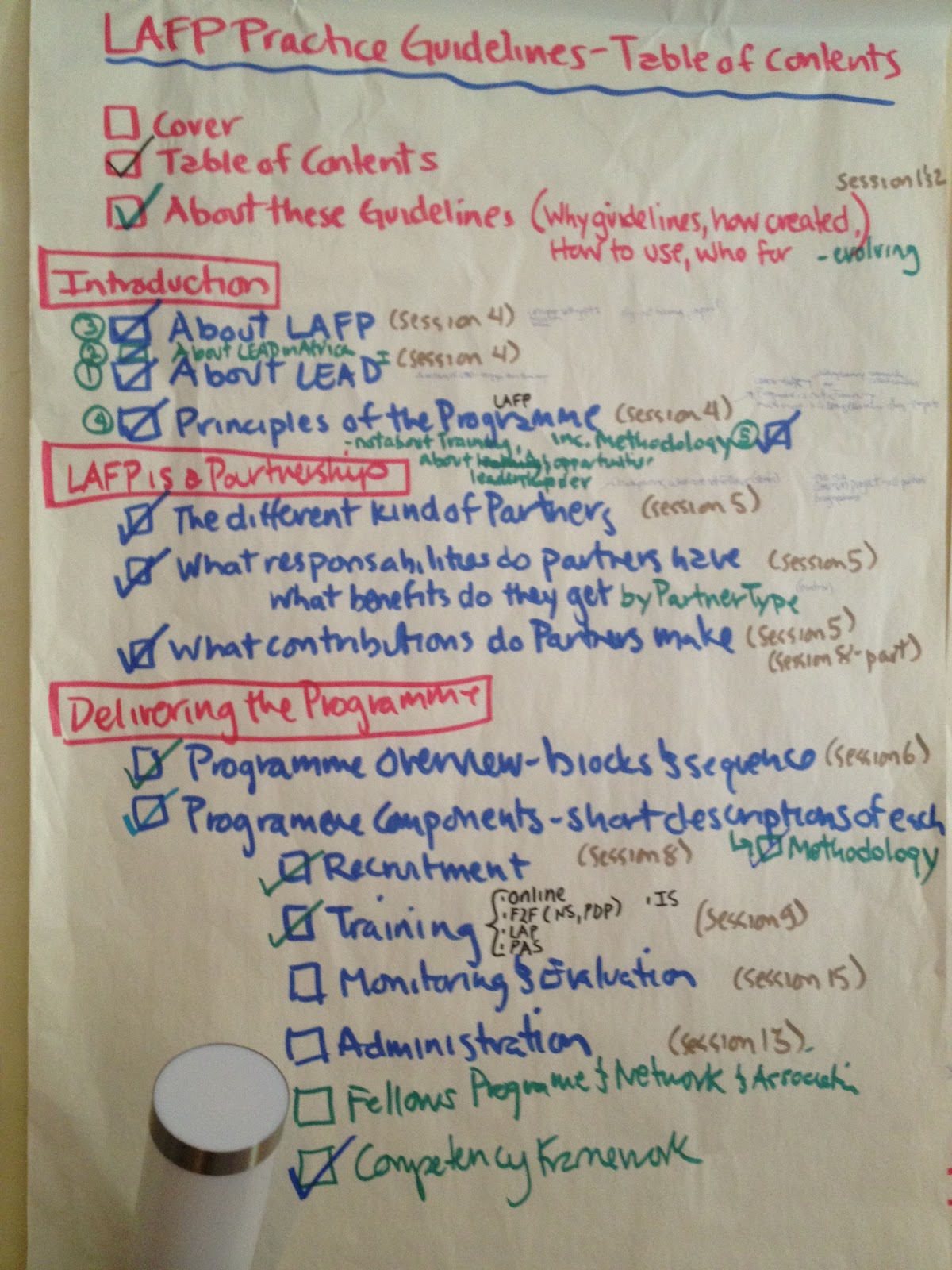
Well, I have done similar learning workshops in the past and have found it very effective to start with the final product in mind as the main organizing principle (as opposed to creating that final document from the notes of less structured discussions), and we did that this time too. We started with the Table of Contents of the Manual we wanted to write.
Imagine holding the Manual in your hands - how you would want to read and use it? When you think of it like this it becomes easier to chunk it down into parts and discussions that can both fill in the sections, and be used structure your workshop. We had a two-flipchart page agenda that we worked from (see above for page 1). I then created our workshop programme such that every session we had corresponded to a specific section of the Table of Contents. I marked the session number on the Table of Contents flipchart so people could see that no time was wasted, every discussion had a purpose and a place in the Manual.
Another helpful tip, if you use this Table of Contents technique, is to make those little checkboxes by each section and sub-section and then ceremoniously tick them off when the group has completed a section. It feels wonderful to see those checkmarks going up and the remaining areas counting down. I also mixed things up a little and didn't always run the sessions in the order of the Table of Contents, but people didn't worry, as they could see that in later sessions we would be getting back to the parts we jumped over.
You can dive right into this exercise, but I think it's better to start with context-setting discussions about why to do such a learning activity, what will make the guidelines immediately useful, and what will make them "stick". It's no good having guidelines that no one ever uses, and instead keep re-creating the wheel. So we started with a few facilitated discussions that helped us answer these questions. (And we also put that in the Manual in the Introduction).
Getting started
1. We started with a check-in where everyone shared 1 set of guidelines that they currently use and why they like to use them (as an aside this also got us into a humerous discussion of what guidelines people don't like - like their cell phone instructions - and what to avoid!). This exercise connected people with one of their own successful user experiences. It also gave us some initial good practice on which we could draw.
2. We then talked more generically about "What makes good guidelines" and we created a list of features based on the examples we had in mind and others we liked. We then discussed what would make them "stick" for us, knowing what we know about our work rhythms and preferences. This gave us more good tips for our own guidelines, which we now know needed to be super concise (no long narratives), user-friendly (bullet points and well signposted), practical (checklists, A5 ringbound format), etc. We flipped this into criteria and used this list again half way through our workshop to check that we were on track, and again at the end. At this point we also clarified who would be using the Guidelines and that was helpful again and again to narrow down what exactly we needed to cover (as in not everything under the sun).
3. At that point we went into the Table of Contents discussion. Based on an initial draft I had made, we added and took away sections until we were all happy with it. By that time we could check off our first 3 or 4 boxes which was very satisfying!
Mix it up
As this is effectively a "write shop" in addition to a workshop, you need to think of ways to animate it so that the easy things get captured quickly and the areas where you need to share the diversity of approaches and potentially make some agreed decisions get the most time in the agenda. So I used lots of quick visual capture techniques based on clear questions (e.g. Who are our partners, what are their benefits, what are their responsabilities, etc.) that let people work individually, in pairs, trios and quads, with short plenaries at the end, to collect that information together. In the end, although it is often done in parallel, people still get to input on everything, so ownership at the end is high.
We used crowdsourcing techniques with post-its (individually, in pairs), carousel discussions with wiki-like features so that we could easily find the groups that made the comments if they were not clear; we used metaplan cards, and for some things straight stand-up facilitation at a flipchart (but little of that). We varied the card colours, the markers, the templates we were using, and we plastered the room with the products of our work and discussion (always keeping our Table of Contents flipcharts right in the middle where it could guide us).
At the end of each night the sections we had worked on during the day were recorded into a Word document in the final Manual format, and we used some time at the beginning of each day, on an LCD projector, to have a quick look at the text to make sure we agreed, and to appreciate how the document was building. This collective review helped make sure that everyone was engaged and agreed with the document's text.
This approach -working with different techniques and in diverse constellations of small groups with lots of real time capture- is very efficient and produces a wealth of content with which to work afterwards. It provides discussion time to share and exchange stories of how, in this case, each group has run different aspects of their training programme and what has worked for them.
In the end we created together a 42-page manual capturing our understanding and practice of delivering this sustainability leadership learning programme - from mission and vision, to shared policies that had been agreed over the years around travel and participation (amazing how hard these are to recall when you need them), to the best recruitment process and forms,through to the optimal implementation schedule to follow through the year, reporting obligations, and many annexes with advertisement texts, Terms of Reference for the governing bodies, feedback form templates etc.
It was wonderful to have had the chance to talk through, visualise and share all the many practices that go into delivery of a great learning programme. And too often we and our organizations don't find the time to reflect and collect our learning and record it in a way that our teams, our partners, and others can share in that learning (now and potentially after we pass the baton). Not to mention the fact that we, ourselves, can also forget our own best practice!
Write it down (and do it in a way that inspires more learning)!
Posted by
Gillian Martin Mehers
at
23:33
2
comments
Labels: Learning, learning organizations
Tuesday, January 31, 2012
Reflecting on Reflection Capture: What You Can Learn From 3 Questions & Colour-Coded Cards
How do you capture the reflections of participants on ideas shared during your event? At the end of the TEDxEcoleHôtelièreLausanne programme, we scheduled the university's music committee to perform a musical interpretation of the event. We knew that they would need up to ten minutes to get their instruments set up and ready to go on stage. A great opportunity to capture some reflections from participants!
We prepared a slide with three questions on it, and handed each participant three colour-coded cards to match. The questions (see photo):
Whilst the band set up, participants discussed these questions with people seated next to them and then wrote their personal response on the cards, which we collected and posted on large boards for everyone to read during the aperitif that followed. The cards generated lots of interest as people learned how differently people experienced the diverse talks. And an important bonus too: it helped them remember things which they may have already begun forgetting in the mash-up of ideas that comes with TEDx events.
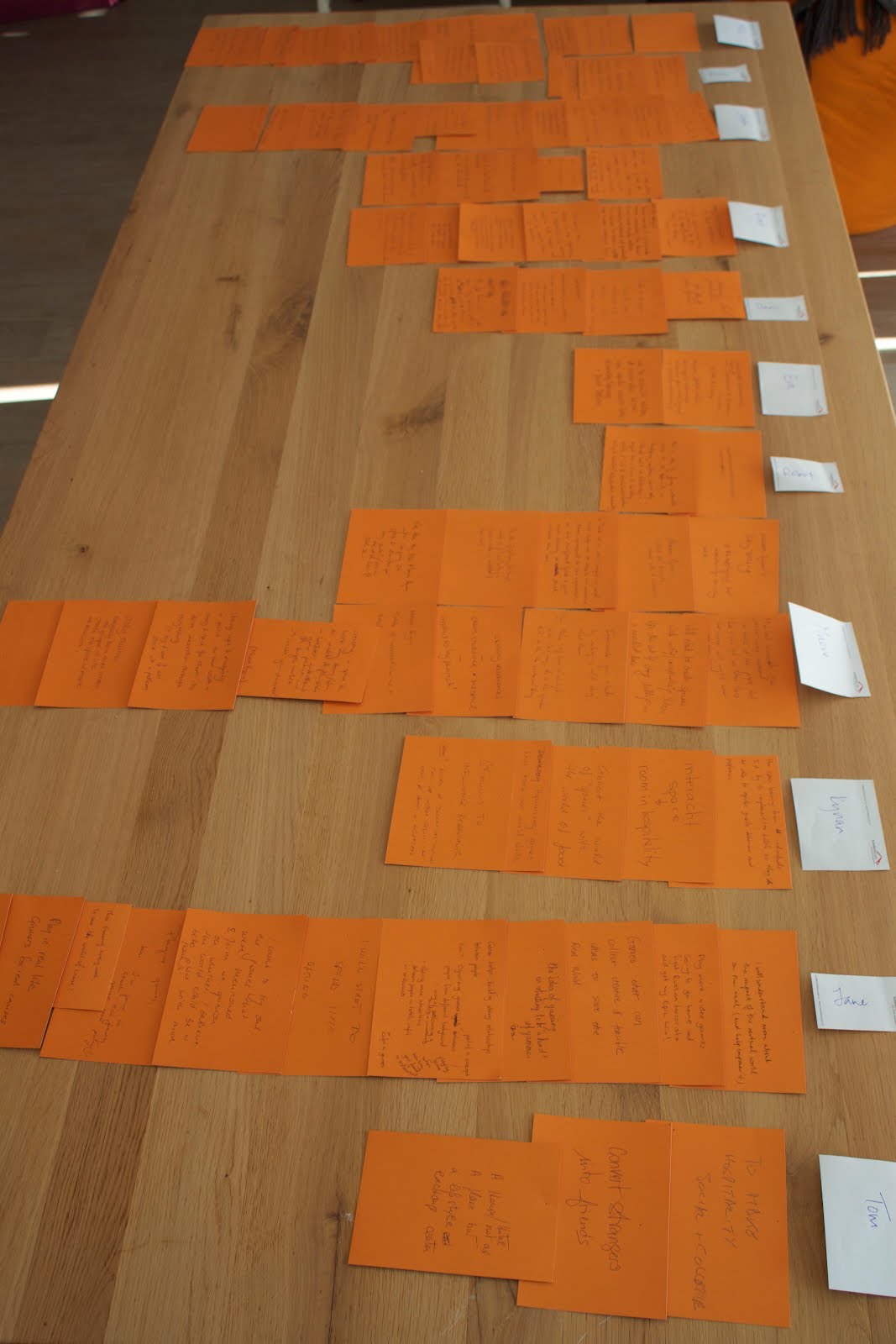
The analysis that we did after the event was also really interesting. We started by sorting the cards according to colour / question, and then regrouped the cards according to the talks they refered to. Laying them out on a table under the speaker's name immediately gave us a bar graph for each question. We could see which speakers were most quoted, which ideas people will most act on, and which people see as potentially having the biggest impact in the future. And then looking at this data collectively, we could see how these three questions elicited very different responses! There was no apparent correlation between people's favourite quotes, facts and figures and action or impact. And, perhaps most interestingly, the ideas that were most seen as potentially having the biggest impact were among those that participants were least likely to act on.
Doing this cards exercise is a quick and easy way to gather a very rich reflection on what people valued about each talk. It also highlights the deficiencies in asking a simple question such as 'which was your favourite talk' because how do people respond? With that which hooked them with a great quote? That which they will act on? Or that which could have huge impact in the future? We are looking forward to the results of the online survey to see if we can see a pattern! What is clear already is that all the speakers were valued for one reason or another, and we're pretty stoked about that :)
p.s. It also enabled us to provide some much appreciated feedback to the speakers... an important part of the often-forgotten post-event speaker care!
Posted by
Elisabeth (Lizzie) Crudgington
at
11:41
2
comments
Labels: Learning, Making Meetings Meaningful, TEDx TEDxEHL TEDxEcoleHôtelièreLausanne
Thursday, January 19, 2012
Some Great Ideas Shared: Tweaked tweets from TEDxEcoleHôtelièreLausanne
The first TEDxEcoleHôtelièreLausanne event took place on Monday 16th of January 2012. Here is a summary of the great ideas shared, based on tweaked tweets from the event, to whet your appetite in anticipation of the videos :)
Live Speaker: Mike Hatrick – “Tales of the Unexpected”
How do you cater for customers’ racehorses? Considering the extreme needs of customers uncovers hidden opportunity. Who is your unexpected IT guy in the bushwacker hat 3’000 miles away with THE idea for the business jet of the future? Could a SWAT team of inexperienced, unusual suspects trump your chief engineer? The game-changing innovation may lie less in the performance of your product and more in experience engaging with it. Get prepared for the unexpected, because the unexpected stuff might be the biggest and the best.
From talking of innovation in unexpected places to an innovative, alternative to Styrofoam from an unexpected source…
TEDTalk Video: Eben Bayer – “Are Mushrooms the New Plastic?”
A single cubic foot of Styrofoam has the same energy content of 1.5litres of petrol… yet it’s thrown in the trash. 20 billion dollars of Styrofoam is produced every year and it occupies 25% of US landfills. Using mushroom mycelium as glue, mold things from agricultural byproducts – replacing Styrofoam cups and packaging!
From mycelium-based packaging to an insightful look at packaging design…
Live Speaker: Sophie Maxwell – “Designing the future of taste”
Should we be packaging food that already has the best kind of natural packaging? Children don’t connect what they eat and where it came from - exacerbated by how we package and deliver food. Rather than hero food & all it's wonders, software-led packaging design created barriers, misrepresentation & bad habits. Quoting Michael Pollen: we shouldn’t eat anything that our grandmother would not recognize as food. Understanding our food should be instinctual, offering direct ways of reconnecting with, and understanding what we eat. The future of taste: a greater appreciation of our food’s virtues & possibilities, clearly communicated and experienced.
From how we perceive packaged food to our perception of the food we eat…
Live Speaker: Birgit Schleifenbaum - “Fuel for Life”
Annual sugar production is 160 million tons/year. This is equal to the quantity of sand needed to build the Dubai Palm Island and requires 240 Trillion litres of water - as much as 3 times the Lake Geneva – to produce. Luckily we are not made of sugar and food is much more than calories: The value of food, the energy it gives us, is to a major extent driven by pleasure! Energy = Calories x Pleasure to the power of 2. Understanding the science of senses and flavour helps increase pleasure and energy from food and protects our health and planet.
From flavour science to the links between flavour, farming and feeds…
TEDTalk Video: Dan Barber – “How I Fell In Love with a Fish”
Questioning a scientist from a fish farm: “Don – what are some e.g.s of sustainable proteins?” The answer: chicken scraps. “After that conversation the fish tasted like chicken”. But, at the feed-free Veta La Palma fish farm in Spain, pink-bellied feasting flamingoes signal the health of the system. To feed ourselves in the future, let’s look to the ecological model, and to farms that farm extensively & restore. “Farmers that are experts in relationships are experts in flavour too and… a better chef than I’ll ever be.”
From an ecological farming model to the ecosystem services mathematics…
Live Speaker: Eva Zabey – “The Economy – It’s Nature’s Business”
How about we use the economy to guard the environment as part of the way we work it? Natural ecosystems provide services not accounted for in today’s economy because they’re not appropriately valued. ALL businesses depend on ecosystems services, even if the extent to which they are aware of this varies greatly. The methodologies are evolving to do the maths necessary to value ecosystem services and make informed decisions. We now have Corporate Ecosystem Valuation tools to smarten our decision-making in business, legislation and policy. Environment versus the economy is so passé. It’s environment in the economy!
From ecosystems to a highline wildscape proving valuable to Manhattan…
TEDTalk Video: Robert Hammond – “Building a Park in the Sky”
Inspired by 1.5 miles of wildflowers running through mid Manhattan on an elevated rail line, a park was born. Friends of The Highline saved it from destruction by creating a wildscape park. It cost $250 Million. Now people estimate the Highline park has / will create about half a billion dollars in tax revenues for the city. “It’s in the people and how they use it (the Highline park) that, to me, makes it so special. Public space has the power to transform how people experience their city and interact with each other.”
From the re-creation of space on a rail line to re-creating space thinking like a novelist…
Live Speaker: Maeve Ryan – “(Re)Creating Spaces – Thinking Like a Novelist”
Thinking like a novelist can open up new ways of pursuing innovation in any number of career paths. Creating a fictional space for a story is not far removed from the process of creating a real space. Readers are tourists. If you want to create something new, to innovate – try starting with a character and write them into story. And as your write your story, remember the novelist’s technique - ‘Show, don’t tell’. Keep on remembering this as you take off your novelist’s hat and create your new product or hospitable space.
From creative writing to creating interactive and influential spaces…
Live Speaker: Kynan Eng – “Interactive and Influential Spaces”
Since early humans we’ve created spaces partitioning us away from a biosphere of highly active & interactive space. In 1923 Le Corbusier said “A house is a machine for living in”. In 1969, B.F. Skinner said machines think (B.F. Skinner 1969). Together these suggest that buildings think. The sort of tracking we are aware of & used to online is now pervading our physical environments. The spaces we create are increasingly interactive and intelligent. They can even be conditioned to learn to influence us.
From interactive spaces to the world of gaming…
TEDTalk Video: Jane McGonigal “Gaming Can Make a Better World”
Game playing gives us urgent optimism, believing that an epic win is possible and worth trying. It weaves a tight social fabric. We like people better after we play a game, even if beaten badly. It takes trust to play a game: trust others will spend their time, play by same rules, value same goal, stay until the end. According to Herodotus, dice games were invented in the kingdom of Lydia and used for 18 years of famine escapism on days with no food. Nowadays (quoting economist Ed Castronova) “We’re witnessing a mass exodus to virtual worlds and online game environments”. We need to tap into this mass human resource for good using gaming to change the world. Let the world-changing games begin!
From gaming to another phenomenon of anthropological interest: hospitality and hostility…
Live Speaker: Tom Selwyn – “Being At Home in the World”
Examples from Ibn Batuta, Genesis and Plato’s Symposium show hospitality’s role in occasions where social relationships are symbolized. Hospitality is in a fundamental sense for society itself, marking the making of social / political alliances and transitions. At the same time, hospitality is first cousin to hostility. From earliest times the refugee has always been the most needy of hospitality, and yet increasingly it is harder to find. Sometimes the same institutions (hotels) that welcome tourists serve as detention centres for refugees. If you had to choose in which industry to invest to promote well-being, would you choose hospitality or hostility (arms)?
From classical music to the music of the EHL Committee…
Music from Ilia Zolas and the EHL Music Committee
Ilia Zolas and EHL’s music committee wrap up the programme, performing a song reflecting the TEDxEcoleHôtelièreLausanne event.
Once available, talks from live speakers will be publicized in the event website: http://tedx.ehl.edu/. The TEDTalk videos are available from ted.com. For latest news, follow @TEDxEHL on twitter. Enjoy!
Posted by
Elisabeth (Lizzie) Crudgington
at
17:15
3
comments