Sunday, February 05, 2012

Capturing Group Learning: Creating Your Own Practice Guidelines

I recently had the opportunity to work with a team of sustainability leadership experts who have been delivering a learning programme for the past few years in different countries in Africa. For many years they delivered very different programmes, but a few years ago they decided to join forces and work towards harmonising their content and process, and share investments in curriculum development.

How did that go?

Well, that was our main question in a recent 3-day workshop to share learning and create a set of Practice Guidelines for the group. The aim was effectively to create a Manual, based on this learning and best practice, on how to run the programme.

You might think it would be more efficient to sit in your office and write that manual, rather than try to jointly write a document in real time, face-to-face with 10 people. However, co-creation is the way to go if you actually want people to use the manual, and is a good way for it to be fortified with the interesting stories that people can tell (but won't necessarily write down in an email or survey) on their experiences over a few years of implementation. You get more spark in the room, and it acually gets done. When you think of it like this then it makes much more sense to get together and collaboratively write such a document. But just the thought of such a discussion might leave people wondering "Where do we start?"

Well, I have done similar learning workshops in the past and have found it very effective to start with the final product in mind as the main organizing principle (as opposed to creating that final document from the notes of less structured discussions), and we did that this time too. We started with the Table of Contents of the Manual we wanted to write.
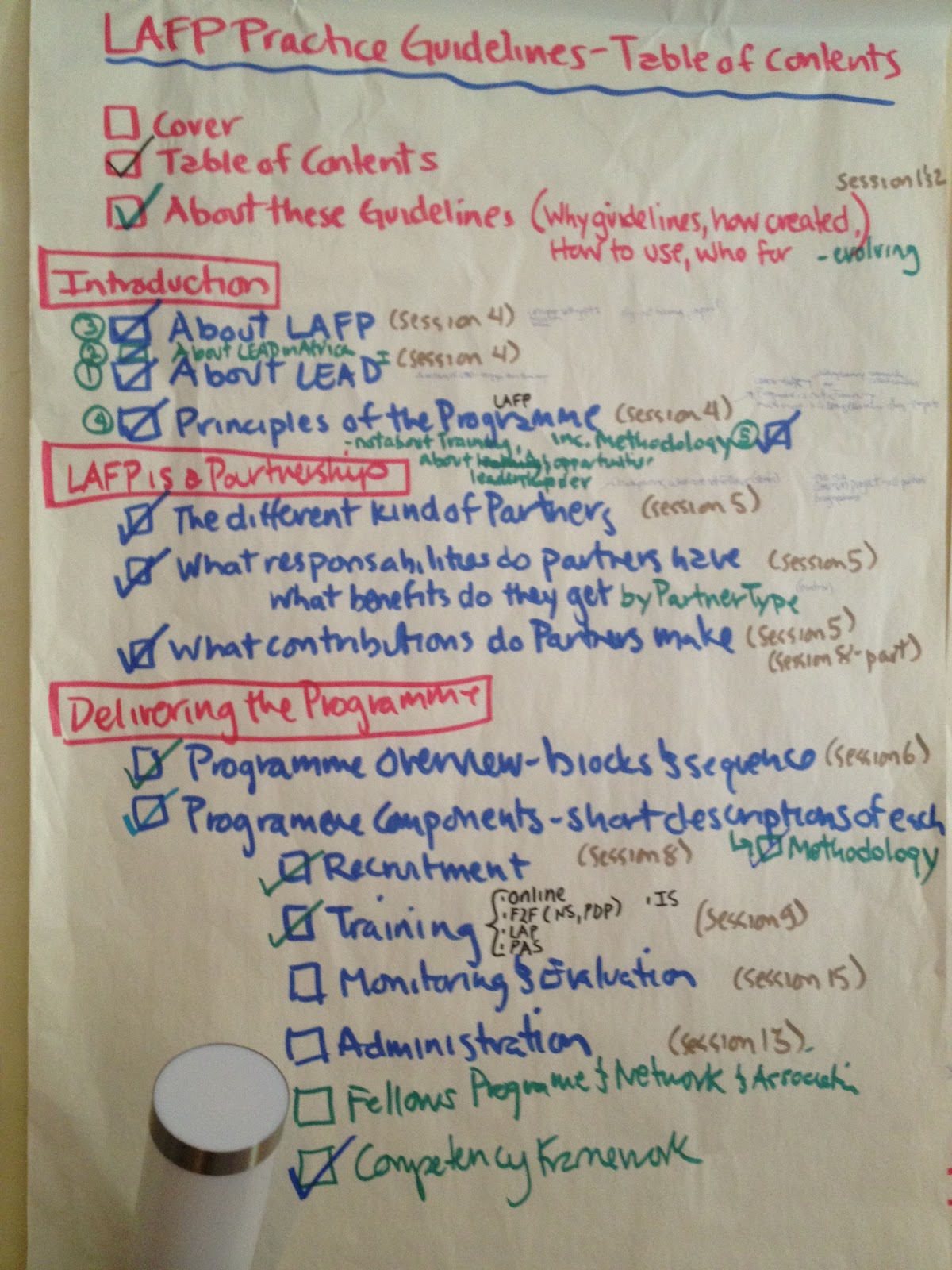

Imagine holding the Manual in your hands -  how you would want to read and use it? When you think of it like this it becomes easier to chunk it down into parts and discussions that can both fill in the sections, and be used structure your workshop. We had a two-flipchart page agenda that we worked from (see above for page 1). I then created our workshop programme such that every session we had corresponded to a specific section of the Table of Contents. I marked the session number on the Table of Contents flipchart so people could see that no time was wasted, every discussion had a purpose and a place in the Manual.

Another helpful tip, if you use this Table of Contents technique, is to make those little checkboxes by each section and sub-section and then ceremoniously tick them off when the group has completed a section. It feels wonderful to see those checkmarks going up and the remaining areas counting down. I also mixed things up a little and didn't always run the sessions in the order of the Table of Contents, but people didn't worry, as they could see that in later sessions we would be getting back to the parts we jumped over.

You can dive right into this exercise, but I think it's better to start with context-setting discussions about why to do such a learning activity, what will make the guidelines immediately useful, and what will make them "stick". It's no good having guidelines that no one ever uses, and instead keep re-creating the wheel. So we started with a few facilitated discussions that helped us answer these questions. (And we also put that in the Manual in the Introduction).

Getting started

1.  We started with a check-in where everyone shared 1 set of guidelines that they currently use and why they like to use them (as an aside this also got us into a humerous discussion of what guidelines people don't like - like their cell phone instructions - and what to avoid!). This exercise connected people with one of their own successful user experiences. It also gave us some initial good practice on which we could draw.

2. We then talked more generically about "What makes good guidelines" and we created a list of features based on the examples we had in mind and others we liked. We then discussed what would make them "stick" for us, knowing what we know about our work rhythms and preferences. This gave us more good tips for our own guidelines,  which we now know needed to be super concise (no long narratives), user-friendly (bullet points and well signposted), practical (checklists, A5 ringbound format), etc. We flipped this into criteria and used this list again half way through our workshop to check that we were on track, and again at the end. At this point we also clarified who would be using the Guidelines and that was helpful again and again to narrow down what exactly we needed to cover (as in not everything under the sun).

3. At that point we went into the Table of Contents discussion. Based on an initial draft I had made, we added and took away sections until we were all happy with it. By that time we could check off our first 3 or 4 boxes which was very satisfying!

Mix it up

As this is effectively a "write shop" in addition to a workshop, you need to think of ways to animate it so that the easy things get captured quickly and the areas where you need to share the diversity of approaches and potentially make some agreed decisions get the most time in the agenda. So I used lots of quick visual capture techniques based on clear questions (e.g. Who are our partners, what are their benefits, what are their responsabilities, etc.) that let people work individually, in pairs, trios and quads, with short plenaries at the end, to collect that information together. In the end, although it is often done in parallel, people still get to input on everything, so ownership at the end is high.

We used crowdsourcing techniques with post-its (individually, in pairs), carousel discussions with wiki-like features so that we could easily find the groups that made the comments if they were not clear; we used metaplan cards, and for some things straight stand-up facilitation at a flipchart (but little of that). We varied the card colours, the markers, the templates we were using, and we plastered the room with the products of our work and discussion (always keeping our Table of Contents flipcharts right in the middle where it could guide us).

At the end of each night the sections we had worked on during the day were recorded into a Word document in the final Manual format, and we used some time at the beginning of each day, on an LCD projector, to have a quick look at the text to make sure we agreed, and to appreciate how the document was building. This collective review helped make sure that everyone was engaged and agreed with the document's text.

This approach -working with different techniques and in diverse constellations of small groups with lots of real time capture- is very efficient and produces a wealth of content with which to work afterwards. It provides discussion time to share and exchange stories of how, in this case, each group has run different aspects of their training programme and what has worked for them.

In the end we created together a 42-page manual capturing our understanding and practice of delivering this sustainability leadership learning programme - from mission and vision, to shared policies that had been agreed over the years around travel and participation (amazing how hard these are to recall when you need them), to the best recruitment process and forms,through to the optimal implementation schedule to follow through the year, reporting obligations, and many annexes with advertisement texts, Terms of Reference for the governing bodies, feedback form templates etc.

It was wonderful to have had the chance to talk through, visualise and share all the many practices that go into delivery of a great learning programme. And too often we and our organizations don't find the time to reflect and collect our learning and record it in a way that our teams, our partners, and others can share in that learning (now and potentially after we pass the baton).  Not to mention the fact that we, ourselves, can also forget our own best practice!

Write it down (and do it in a way that inspires more learning)!

Tuesday, January 31, 2012

Reflecting on Reflection Capture: What You Can Learn From 3 Questions & Colour-Coded Cards

How do you capture the reflections of participants on ideas shared during your event? At the end of the TEDxEcoleHôtelièreLausanne programme, we scheduled the university's music committee to perform a musical interpretation of the event. We knew that they would need up to ten minutes to get their instruments set up and ready to go on stage. A great opportunity to capture some reflections from participants!

We prepared a slide with three questions on it, and handed each participant three colour-coded cards to match. The questions (see photo):

Whilst the band set up, participants discussed these questions with people seated next to them and then wrote their personal response on the cards, which we collected and posted on large boards for everyone to read during the aperitif that followed. The cards generated lots of interest as people learned how differently people experienced the diverse talks. And an important bonus too: it helped them remember things which they may have already begun forgetting in the mash-up of ideas that comes with TEDx events.

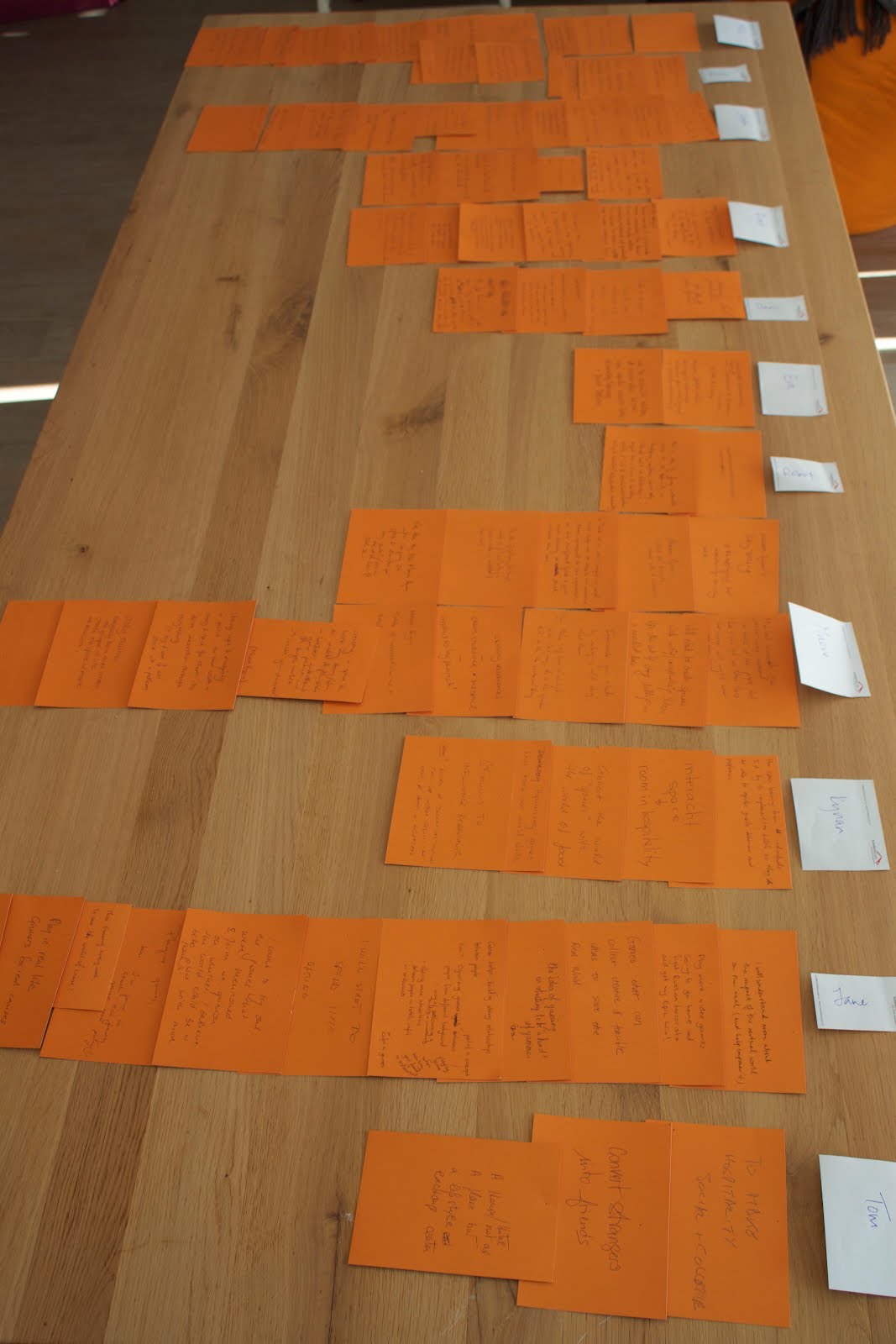
The analysis that we did after the event was also really interesting. We started by sorting the cards according to colour / question, and then regrouped the cards according to the talks they refered to. Laying them out on a table under the speaker's name immediately gave us a bar graph for each question. We could see which speakers were most quoted, which ideas people will most act on, and which people see as potentially having the biggest impact in the future. And then looking at this data collectively, we could see how these three questions elicited very different responses! There was no apparent correlation between people's favourite quotes, facts and figures and action or impact. And, perhaps most interestingly, the ideas that were most seen as potentially having the biggest impact were among those that participants were least likely to act on.

Doing this cards exercise is a quick and easy way to gather a very rich reflection on what people valued about each talk. It also highlights the deficiencies in asking a simple question such as 'which was your favourite talk' because how do people respond? With that which hooked them with a great quote? That which they will act on? Or that which could have huge impact in the future? We are looking forward to the results of the online survey to see if we can see a pattern! What is clear already is that all the speakers were valued for one reason or another, and we're pretty stoked about that :)

p.s. It also enabled us to provide some much appreciated feedback to the speakers... an important part of the often-forgotten post-event speaker care!

Thursday, January 19, 2012

Some Great Ideas Shared: Tweaked tweets from TEDxEcoleHôtelièreLausanne

The first TEDxEcoleHôtelièreLausanne event took place on Monday 16th of January 2012. Here is a summary of the great ideas shared, based on tweaked tweets from the event, to whet your appetite in anticipation of the videos :)

Live Speaker: Mike Hatrick – “Tales of the Unexpected”

How do you cater for customers’ racehorses? Considering the extreme needs of customers uncovers hidden opportunity. Who is your unexpected IT guy in the bushwacker hat 3’000 miles away with THE idea for the business jet of the future? Could a SWAT team of inexperienced, unusual suspects trump your chief engineer? The game-changing innovation may lie less in the performance of your product and more in experience engaging with it. Get prepared for the unexpected, because the unexpected stuff might be the biggest and the best.

From talking of innovation in unexpected places to an innovative, alternative to Styrofoam from an unexpected source…

TEDTalk Video: Eben Bayer – “Are Mushrooms the New Plastic?”

A single cubic foot of Styrofoam has the same energy content of 1.5litres of petrol… yet it’s thrown in the trash. 20 billion dollars of Styrofoam is produced every year and it occupies 25% of US landfills. Using mushroom mycelium as glue, mold things from agricultural byproducts – replacing Styrofoam cups and packaging!

From mycelium-based packaging to an insightful look at packaging design…

Live Speaker: Sophie Maxwell – “Designing the future of taste”

Should we be packaging food that already has the best kind of natural packaging? Children don’t connect what they eat and where it came from - exacerbated by how we package and deliver food. Rather than hero food & all it's wonders, software-led packaging design created barriers, misrepresentation & bad habits. Quoting Michael Pollen: we shouldn’t eat anything that our grandmother would not recognize as food. Understanding our food should be instinctual, offering direct ways of reconnecting with, and understanding what we eat. The future of taste: a greater appreciation of our food’s virtues & possibilities, clearly communicated and experienced.

From how we perceive packaged food to our perception of the food we eat…

Live Speaker: Birgit Schleifenbaum - “Fuel for Life”

Annual sugar production is 160 million tons/year. This is equal to the quantity of sand needed to build the Dubai Palm Island and requires 240 Trillion litres of water - as much as 3 times the Lake Geneva – to produce. Luckily we are not made of sugar and food is much more than calories: The value of food, the energy it gives us, is to a major extent driven by pleasure! Energy = Calories x Pleasure to the power of 2. Understanding the science of senses and flavour helps increase pleasure and energy from food and protects our health and planet.

From flavour science to the links between flavour, farming and feeds…

TEDTalk Video: Dan Barber – “How I Fell In Love with a Fish”

Questioning a scientist from a fish farm: “Don – what are some e.g.s of sustainable proteins?” The answer: chicken scraps. “After that conversation the fish tasted like chicken”. But, at the feed-free Veta La Palma fish farm in Spain, pink-bellied feasting flamingoes signal the health of the system. To feed ourselves in the future, let’s look to the ecological model, and to farms that farm extensively & restore. “Farmers that are experts in relationships are experts in flavour too and… a better chef than I’ll ever be.”

From an ecological farming model to the ecosystem services mathematics…

Live Speaker: Eva Zabey – “The Economy – It’s Nature’s Business”

How about we use the economy to guard the environment as part of the way we work it? Natural ecosystems provide services not accounted for in today’s economy because they’re not appropriately valued. ALL businesses depend on ecosystems services, even if the extent to which they are aware of this varies greatly. The methodologies are evolving to do the maths necessary to value ecosystem services and make informed decisions. We now have Corporate Ecosystem Valuation tools to smarten our decision-making in business, legislation and policy. Environment versus the economy is so passé. It’s environment in the economy!

From ecosystems to a highline wildscape proving valuable to Manhattan…

TEDTalk Video: Robert Hammond – “Building a Park in the Sky”

Inspired by 1.5 miles of wildflowers running through mid Manhattan on an elevated rail line, a park was born. Friends of The Highline saved it from destruction by creating a wildscape park. It cost $250 Million. Now people estimate the Highline park has / will create about half a billion dollars in tax revenues for the city. “It’s in the people and how they use it (the Highline park) that, to me, makes it so special. Public space has the power to transform how people experience their city and interact with each other.”

From the re-creation of space on a rail line to re-creating space thinking like a novelist…

Live Speaker: Maeve Ryan – “(Re)Creating Spaces – Thinking Like a Novelist”

Thinking like a novelist can open up new ways of pursuing innovation in any number of career paths. Creating a fictional space for a story is not far removed from the process of creating a real space. Readers are tourists. If you want to create something new, to innovate – try starting with a character and write them into story. And as your write your story, remember the novelist’s technique - ‘Show, don’t tell’. Keep on remembering this as you take off your novelist’s hat and create your new product or hospitable space.

From creative writing to creating interactive and influential spaces…

Live Speaker: Kynan Eng – “Interactive and Influential Spaces”

Since early humans we’ve created spaces partitioning us away from a biosphere of highly active & interactive space. In 1923 Le Corbusier said “A house is a machine for living in”. In 1969, B.F. Skinner said machines think (B.F. Skinner 1969). Together these suggest that buildings think. The sort of tracking we are aware of & used to online is now pervading our physical environments. The spaces we create are increasingly interactive and intelligent. They can even be conditioned to learn to influence us.

From interactive spaces to the world of gaming…

TEDTalk Video: Jane McGonigal “Gaming Can Make a Better World”

Game playing gives us urgent optimism, believing that an epic win is possible and worth trying. It weaves a tight social fabric. We like people better after we play a game, even if beaten badly. It takes trust to play a game: trust others will spend their time, play by same rules, value same goal, stay until the end. According to Herodotus, dice games were invented in the kingdom of Lydia and used for 18 years of famine escapism on days with no food. Nowadays (quoting economist Ed Castronova) “We’re witnessing a mass exodus to virtual worlds and online game environments”. We need to tap into this mass human resource for good using gaming to change the world. Let the world-changing games begin!

From gaming to another phenomenon of anthropological interest: hospitality and hostility…

Live Speaker: Tom Selwyn – “Being At Home in the World”

Examples from Ibn Batuta, Genesis and Plato’s Symposium show hospitality’s role in occasions where social relationships are symbolized. Hospitality is in a fundamental sense for society itself, marking the making of social / political alliances and transitions. At the same time, hospitality is first cousin to hostility. From earliest times the refugee has always been the most needy of hospitality, and yet increasingly it is harder to find. Sometimes the same institutions (hotels) that welcome tourists serve as detention centres for refugees. If you had to choose in which industry to invest to promote well-being, would you choose hospitality or hostility (arms)?

From classical music to the music of the EHL Committee…

Music from Ilia Zolas and the EHL Music Committee

Ilia Zolas and EHL’s music committee wrap up the programme, performing a song reflecting the TEDxEcoleHôtelièreLausanne event.

Once available, talks from live speakers will be publicized in the event website: http://tedx.ehl.edu/. The TEDTalk videos are available from ted.com. For latest news, follow @TEDxEHL on twitter. Enjoy!

Wednesday, January 18, 2012

Congruence in Event Design: When It Tastes As Good As It Looks - Learning from #TEDxEHL

We just helped put on a TEDx event hosted by the Ecole Hôtelière de Lausanne (EHL) on the future of hospitality which had a string of amazing speakers exploring "ideas worth spreading" from how our human spaces will increasingly interact with us, how to put together an unlikely "SWAT team" to solve a problem that needs innovation, why thinking like a novelist can help you create the perfect cafe, meat as the luxury item of the future, why if there is no nose there is no fun...and more.

With a topic like hospitality, and an audience filled with EHL alumni, partners and others for whom the hospitality industry is their bread and butter, no only did the talk selections have to be surprising - the curation aimed to scope future surprising trends from other fields such as neuroscience, storytellers, gamers, flavour science, anthropologists and innovation engineers - but the surroundings also had to step up to the plate  (ok, that's baseball, but think porcelain in this case).

And, we were in one of the most famous hotel schools in Switzerland, so that gave some excellent grounds for innovation.

For the coffee break, it would have seemed odd to have just coffee and biscuits, so the school served at their coffee break hand made icecream in delicious popcorn flavour, in white wine flavour, and caramel which they made with liquid nitrogen right in front of us and served in tiny dishes. 

They also capped every coffee with an intricate design in chocolate which they did at amazing speed.

For the reception, the students created a special TEDx cocktail which was red and delicious and and matched with an equally interesting and flavourful tower of mini "icecream" cones filled with a mousse of truffle and foie gras.
The whole event was a full sensory experience, the ideas were exhilarating and, of course, the hospitality was excellent!

(PS. Find a running commentary of the event and key speaker ideas on Twitter at #TEDxEHL or with the tag TEDxEcoleHoteliereLausanne)

Wednesday, January 11, 2012

A New Year's Commitments: Where Do You Choose to Spend Your Time?

It is that time of year when, if you have time, you review the past year and think about what you learned; what you would like to continue to do; and what you might like to do more of, or do differently.

I took on  a part-time project last June which, if it had been half time (although what even is half time for an independent worker?) would have had a manageable effect on my overall time allocation. I could organize myself for that. But by the end of a rather frazzled year I was left feeling like I didn't have a minute for anything non-obligatory. What happened to fun time, or reading time, or even lunch time?

I was given an excellent exercise at the very end of last year by a wise advisor - so simple, yet powerful in its help in thinking about this issue of time, and the choices that we make in spending it. Here it is, try it for yourself:

You have 168 hours each week (7 days x 24 hours each day) (this is, sadly, non-negotiable)

1. How many hours do you want to sleep each day? (x 7, calculate and subtract)
(Bear in mind that this is not necessarily what you do, but what you want to commit yourself to doing because you, in this case, value your health - think sustainability, not getting over the next major project deadline.)

2. How many hours do you spend eating each day (x 7, calculate and subtract)

3. How many hours do you want to spend together with your family each day? (x 7, calculate and subtract)
(If this some of this is built into eating, then add the additional non-sitting-at-the-table time)

4. How many hours a day on average do you want to spend alone with your partner or spouse? (x 7, calculate and subtract)

5. How many hours a day do you want to spend on personal care (showers, brushing your teeth, you get the idea) (x 7, calculate and subtract)

You see where this is going.  Here are a few more categories to consider and calculate, and you can add your own:

6. Personal development and balance? (reading, yoga, exercise, blogging)
7. Travel or commuting?
8. Time with friends?
9. Time in the garden or with important hobbies?
10. Time spent doing menial housework and picking up after other people (I added "housework" to my list - you might be lucky enough not to have to add that, or have usefully reframed that into "balance", but not me)

Do the math. What you have left is time for WORK.

You might be surprised by what you get. Do you (choose to) do more than that "work" stuff than you have time allocated, and if so, what is "paying for" that time - is it sleep, eating, time with friends/family, etc.? I tried to be realistic about what I could spend and still stick to my personal values, and priorities. This exercise gives you the opportunity to think through those again and be clear about your commitments and choices, in terms of how you spend the hours of your day, week and life.

What I came up with when I did the math was exactly 39 hours available for work. If I divide that between my independent work and my new project, then I do have 20 good hours a week for the latter, which is exactly what I had agreed to do - half time. So now it is up to me to spend that time, and not more, or at least as an exception and not as a rule, in order to keep myself on track in the New Year. This little exercise makes those time decisions much clearer.

What about you? How are you spending your time?

(I have written quite a few blog posts about time - from time in big blocks to tiny increments - it is clearly a topic that holds curiosity for me. No wonder I liked this exercise! Here are a few I like: The Work at Home Field Guide to Time, The Time it Takes: A Learning Practitioner's Lessons on Time, and  Time to Reflect: Cooking Up Your Weekly GTD Review)

Tuesday, December 06, 2011

Facilitators: To Your Health!

I prepared a 54-page Facilitator's Guide for the workshop this week, a master list of materials, a session-by-session description of what job aids to make in advance of the event, and a mock-up of every flipchart we would have to draw on site. We had a detailed facilitation agenda, and a script ready for each session that would be lead, we even had a minute-by-minute design for our pre-event facilitation briefing.

However, in the instructions I created to help prepare our 8-person facilitation team, one piece of guidance was clearly missing - take care of your health.

I didn't say, make sure to get good sleep in the week before you come, take your vitamins, drink plenty of water, and don't stay out too late. I didn't say, don't try to get absolutely everything out of the way in the nights before you take that transcontinental overnight flight, and don't cut it too close on arrival so you can rest before we start our very full programme of activities.

Maybe Facilitators think they are a bit super human, dealing with the emotions of large crowds, handling stressful environments, holding the hopes and dreams and fears of a group of passionate people, getting up early and staying up late setting up the room and moving dozens of chairs, or running miles to find hotel staff and trying for the 100th time to get them to turn off the aircon in the room.

But on our preparation list in the future must absolutely be the husbanding of our own resources in the days before a big event, and during it. Otherwise, we risk being taken out by an opportunistic bug, wicked jet lag exacerbated by sleep deprivation, or worse. And while it is no fun for us, it is also no fun for our team members and our partners.

It hit home again today, I am not sick myself, but as the leader of the facilitation team and seeing it around me, I am sorry that I didn't write that note. And at the same time wonder, even if I did, if the Facilitation Team members would have done something different in preparing themselves for this event? I know this community. I write this at nearly midnight in Bangkok after a long long day, and after promising myself an early night.

Once I push "Publish" I'm off to bed, I promise myself, to take my own good advice...

Tuesday, November 29, 2011

Online Educa: Follow Us There!


We're going to Online Educa, 17th International Conference on Technology Supported Learning & Training, purported to be the "Largest Global E-Learning Conference for the Corporate, Education and Public Service Sectors"

This annual global virtual learning fest is held in Berlin from 1-2 December. Lizzie and I will be tweeting from the conference (follow us @GillianMMehers and @Lizzie_BGL ). We will be especially looking out for game-based learning, badging, and video learning innovations. We will also blog the conference. If you are interested in these kinds of things, they have a great online newsletter called OEB News.

Tuesday, November 15, 2011

Preparing a Pecha Kucha: One Pragmatic Approach

How do you go about creating a Pecha Kucha? Well, growing experience with them is teaching us that the process is often quite the opposite of what we usually see when people begin a traditional PowerPoint presentation. Are you among those who start by annotating blank slides with key words and messages and then let the presentation grow from there, hoping the logic will somehow make it work? If so, you’re not alone, and like many if you try and fit this to a Pecha Kucha format you may struggle to match your messages meaningfully across to the 20 x 20 second timed slides. How about trying a different approach? Begin by writing a story. Then match your story across to slides for a much more compelling narrative with visual support. Here’s how.

In preparation for a recent event at which we demonstrated techniques for engaging groups in thinking, learning and working together, we asked one of our favourite clients (thanks Mark!) to help us. We challenged him to create and deliver a Pecha Kucha and he was happy – if a little daunted at first – to oblige. This blog post shares his valuable, pragmatic approach.

Step 1: First determine your key messages – what do you want your audience to think, feel and do as a result of your presentation - and write your story to get your key messages across. (Click here for our blogpost on storytelling.)

Step 2: Practice telling your story aloud and tweak it until it tidily fits into 6 minutes – making sure to breathe, leave pauses, allow time for the audience to absorb what they are hearing and so forth.

Step 3: Once happy with your story, it is time to divide it into 20-second chunks. Literally read and time it out, marking into your script every time 20 seconds passes.

Step 4: Create a table with two columns and twenty rows (for the twenty x 20 second slides you will eventually have). Cut and paste each the 20-second chunks of script into twenty rows of the table. At this point, you may choose to again tweak the text so that it fits more comfortably with the slide breaks.

Step 5: For each 20-second chunk of script, find an image or select one or two key words that best support the content. Enter these into the left hand column of the table.

Step 6: Convert the left hand column of your table into your twenty slides. And, with a little practice, you are ready to go!

Now, a little anecdotal experience... if all of sudden your presenter can’t make it, they may just be able to hand the whole thing over to a trusted colleague! With a timed script ready to go and clearly linked across to the slides, a little time to read and digest was all that was needed for someone else to come to the rescue and do a truly superb job. Pecha Kucha preparation pays!

_____________________

For more on Pecha Kuchas, see our many earlier blog posts (enter 'pecha kucha' in the search box - left column. Here are a couple of our favourites:

- Taking the Long Elevator: 13 Tips for Good Pecha Kuchas

- The End of Boring: Borrowing, Mashing, Adapting for Facilitators

Using Spectrums, Sticky Dots & Templates to Explore ‘What Is’ & ‘What Could Be’

Let’s take an example. Imagine you want to have a conversation about future meetings in a large team or organization with a view to – no surprise here – improving them. You likely have opinions about meetings and how they need to improve in the future. All well and good; but in order to get others on board with this change, you need to explore their opinions about meetings and what improvement might look like. So you decide on a quick and easy way to explore what is and what could be.

On A3 sheets around the room, you have converted some statements about meetings into spectrums. On one, for example, is a spectrum with two axes. At one end of the y-axis it reads: “We always get the task done” and the other end it reads “We never get the task done”; and on the x-axis: “We always feel great about the result” and at the other end “We rarely feel great about the result”. On another sheet, you might have a spectrum related to the quality and quantity of participation. On others, a grid question addresses the amount of time spent in different thinking modes (with the thinking modes – critical, creative, etc. - as the column headers and % brackets in the rows – 0-25%, 25-50%, etc.) and a multiple-choice question is about the efficiency of time spent (with different rows from not efficient to very efficient).

With your spectrums in place, you give participants sticky dots and invite them to tour the room independently, placing their sticky dots in appropriate places on the spectrums of various formats. In the first instance, they should place their sticky dots to describe ‘what is’. Next, either using the same spectrum or an identical one stuck on the same board, repeat the exercise but this time using sticky dots of a different shape or colour to describe ‘what could/should be’.

Once everyone has contributed, it’s time to look at the results. You could choose to do this in plenary, but I recommend taking it a step further. Divide the group up into a number of smaller groups (corresponding to the number of spectrums) and provide them with a flipchart template to complete. Give each one spectrum and ask them to complete the template: (1) briefly describe the results; (2) analyze / suggest reasons for the results / assumptions behind them; and then (3) suggest how to get from ‘what is’ to ‘what could/should be’. Allow them 15 minutes to do this work, and then have each group report back to the rest, providing opportunity for others to then react and provide additional ideas.

This process is a great way of generating and quickly analyzing large amounts of information in a highly interactive, participatory way. The outputs are very visual, making great reference material throughout the event that follows. It is really valuable for clarifying perspectives on what is and what could/should be, the direction that the group want to head in, as well as beginning the conversation about how to make change in the desired direction. Try it and let us know how you get on.

Thursday, November 10, 2011

Sustainable Development - The Words on the Lips of Experts

Every year I go to the Balaton Group Meeting eager to meet old friends, to engage, listen and learn more about what is on the frontier of sustainabilty thinking. This group of 55+ systems modellers, sustainable development experts, professors, practitioners and activists gather annually for a 5-day meeting to explore and share and ponder the past, present and future of the planet. They work to understand the dynamics, identify the leverage points for change, and search relentlessly for where the hope is.

I took pages and pages of notes this year (the 30th meeting, on the shores of Lake Balaton), and when I looked back at these notes just now I asked myself where the weight of the discussion lay - the models, the math, the crises, the peaks, the systems? When I put all my notes into a wordle, the above popped out.  I think it speaks for itself...

Thursday, October 27, 2011

Resonate With Your Audience. Here's How...

Watch this video of Nancy Duarte talking about sparkline.

I have often found myself making reference to the ideas of Nancy Duarte. She spoke to me and a group of TEDx-ers on a pre-opening backstage tour of TED2011 early this year about storytelling and presentations that "Resonsate" - the title of her recent book. In my blog post "TEDxWorkshops, Talks, Tips and Tweets..." I recalled my tweets from her talk: Nancy Duarte on storytelling formula: What is - what could be - what is - what could be - what is - call for action - the utopian new bliss. / Nancy Duarte quotes Ernest Hemmingway: “The first draft of anything is shit.” / Nancy Duarte quotes Woodrow Wilson: “If I have 10 minutes to present I need a week to prepare; if I have an hour I am ready now.”

I have since quoted these myself many times when working with people preparing presentations, and am delighted to say that I just today discovered this short video of Nancy giving much the same talk. Watch it. And once you've done so, look at the links on the webpage under the heading 'Extended Web Content'. Here you can click through to examples of how the formula applies to talks - including by Benjamin Zander, Ronald Reagan and Feynman. I think these are very useful to see it in practice, and trust that you too will find this a great resource for thinking about your presentations in the future. Let us know how you get on!

Thursday, October 06, 2011

10 Systems Thinking Books Recommended by Pegasus

If you are interested in Systems Thinking, then Pegasus Communications (Systems Thinking in Action - based near Boston) writes the useful Leverage Points Blog.  With posts on everything from What it Takes to Lead a "Tribe" to 10 Useful Ideas on Systems Thinking.

One of the posts that caught my eye as particularly practical is their post listing 10 Favourite Systems Thinking Books of the Past 10 Years (or So). I have most of these books, and indeed they are my go-to texts when either learning or helping others learn systems thinking. They range from the technical textbook of John Sterman (Business Dynamics) to story-based learning about systems from Linda Booth Sweeney. From the first person examples from daily life on a farm that Dana Meadows narrates, to the future projections of the World 3 Model as written up in Limits to Growth by Dennis and Dana Meadows and Jorgen Randers.

I wanted to make a note here on this blog to remember this useful list and also connect the article to one of the most enlightening texts on systems thinking that I have found, and is referred to as a classic, which Dana Meadows wrote called: Leverage Points: Places to Intervene in the System. This is a list of intervention points in increasing order of effectiveness - from numbers to mindsets - which creates an incredible checklist for any aspiring change maker.

Sunday, October 02, 2011

Thumb Wrestling for SMART People


I wrote in a past blog post about using Appreciative Inquiry to "makeover" the lessons from a great team game called Thumbwrestling. The post was called: Activity Makeover Using Appreciative Inquiry: From STUPID to SMART.

In that blog post I go through in some detail the debriefing, after the action happens (see that post for this info). But I didn't describe the main set up, briefing and steps of play. I had a request recently to describe the game administration, so I post them here for information.

First of all, I was delighted to find that Thumb Wrestling (aka ThumbWar) is really well described here in Wikipedia. I was interested to read that in some of the chants that are used (by children I guess, I have never heard them in my workshops) the phrase "You are stupid and I am great" is used. It is interesting that we often used (in the past) STUPID as a mnemonic to help understand what structure creates the behaviour of competition (Small goals, Time pressure, Untrusting partners, etc.). In the blog post mentioned above, we used an Appreciative Inquiry approach to make that over into then new mnemonic of SMART or SMARTS.

Thumbwrestling Game

To set the game up, the Game Operator announces that "We will engage in a simple competition called Thumb Wrestling. Everyone needs to find a partner to play". At that point the Game Operator also finds a partner to do a quick demonstration; someone who has been briefed to demonstrate a rather aggressive style of play. In the demo, you lock hands with your demo partner and tell people that their goal is to "Get as many points as you can." You inform people that they will have 15 seconds to do this, and then you demo how to make a point by elaborately struggling to pin the thumb of your opponent, warning people not to hurt each other. Ask everyone to keep track of their own points. You then shout "Go!" and time out the 15 seconds, shout out a 2 second warning.

In the debriefing, you can survey how many points people got, and then have the pair with the highest points demonstrate their style, which is bound to be collaborative, based on trust and their ability to ignore norms, models, language, time pressure, and small goals which normally influence people to play this game in a highly competitive way. Now the blog post on debriefing kicks in - so see that for more!

The description above should be enough to help anyone run the game as a team building exercise (again see the previous post for debriefing). If you want a better description with the systems thinking frame, with more precise timing and briefing/debriefing questions, Linda Booth Sweeney and Dennis Meadows have written them up in the Systems Thinking Playbook, which also includes a DVD of someone running all the games so you can see exactly how to administer them.

Happy wrestling!

Saturday, October 01, 2011

Training Camp! An Un-ToT Design

(Warning, this is a long blog post and rather detailed in terms of design thinking for Training Trainers. If you are a ToT organizer or trainer/facilitator it might be useful. If not, then you will want to check your Dilbert RSS feed right now.)

There seem to be cycles in our learning work and we seem to be in a "training" cycle now - with several ongoing projects to help groups create learning environments for themselves and others. I am not as fond of the word "training" as "learning", for me the former seems to come from the perspective of the provider, with the latter from the perspective of the user of the knowledge or information. From a design perspective, I find more inspiration when I can put myself in the knowledge user or learner's shoes. I know that for the learner a Training of Trainers (ToT)  exercise is a step with a group into the unknown...

There are many ways to create ToT environments and we also know that a great deal of the work that a new trainer (or learning facilitator) needs to do is individual. (See my blog post on "Training-of-Trainers from the Trainee's Point of View".) And if much of the work is about individual assimilation of content and methods for creating that learning environment for participants, then the ToT design should feature lots of guided individual and group learning spaces.

Many of the ToT designs that I see follow a set sequence:
  • an overview of the workshop that is being shared, with rationale, and partners behind it;
  • an introduction to the group of Trainers (trainees in the ToT) and their experience and motivations;
  • an expanded set of sessions that follow the workshop outline - each with a demo of the content by a content expert and then Q&A;
  • a session on adaptation to the local context with a discussion, group work and individual action planning;
  • a run through of the workshop with the new Trainers on delivery (the whole or parts of it).
This is a logical sequence and I have used it or something like it myself, sometimes with a full demo up front so the new trainers can experience it as participants, followed by the deconstruction of the workshop to go through the content and exercises that would be delivered when the trainers are back home.

I am currently thinking about how to do this a little differently these days, to make it more learner centred, and to draw upon some of the interesting "camp" designs that have featured in other sectors for peer learning. This interests me more as I come to the realisation that so much of the "translation" work for new trainers (moving from reading the Trainers Manual to them standing up and delivering it) is individual and can look very different trainer to trainer.

What if you combined ideas from the family of non-traditional events such as Bar Camps,  Foo Camps, Unconferences, and the inspiration for these - Open Space Technology - for a ToT, to come up with a Training Camp?

What might this look like? Here is a possible design for a 3-day Training Camp...

Training Camp Day 1:
  • You could start similarly to the more traditional ToT, just to put people at ease, and to provide context to Trainees, and to give some of the background that is needed to work together (why are we doing this? who we are? what we are bringing to the discussion). Then do an initial slow Walk Through of the base workshop (the one everyone is learning.) Expect everyone's eyes to glaze over at some point.
  • Then you might give the Trainers 30 minutes or so of Individual Work to look through the Trainer's Manual again (let's assume that you were able to send the manual in advance and they didn't want until that morning at breakfast to read through it) and highlight some things they would like to explore further. You might make them a simple Job Aid/worksheet to capture questions/types of questions that would help them frame the kind of sessions they would like to have to learn to use the information in the manual;
  • This could be followed by an hour of Pairs Work to talk through some of their questions to weed out any easy ones (this could even be a Pairs Walk if you are in a beautiful location and people's curiosity is already getting the better of them). This could be followed by a Plenary Exchange of what kinds of things people are identifying for more focused work.
  • Finally, you could open up the Training Camp space, and ask people either individually or in Pairs/Trios to propose learning sessions that they would like to host that afternoon, and schedule those using a simple matrix of time and space, as you would for setting up an Open Space Technology session (See photo for set up). The kinds of things people might want to discuss could include specific activities in the workshop design, content pieces they want to understand better, strategies for getting their participants attention, ideas for daily check-ins, how to identify and involve local content experts. Each session should have an output -  a set of tips, a checklist, a guidance note, or some key steps to follow, etc. - which could be captured on flipcharts and/or electronically and shared with the rest of the trainers, and put into the Trainers Guide (for the future). 
  • Then the scheduled Training Camp session would run itself for the rest of the afternoon. At the end, you could have an individual  reflective time where the trainers could make some notes for themselves on what they learned and what they want to remember. I am a fan of worksheets and job aids with good prompting questions, and I can imagine something like this to both complement the Camp sessions, and also to use at the end of the day.
Training Camp Day 2:
  • You could start the second day with a Table Discussion and Exchange of what people learned from the sessions on the first day (they could share their flipchart artifacts). What were some of the things that they learned that they thought were most useful for their own delivery of the training course under consideration? Take some of the most useful things from the table discussion into a Plenary Collection.
  • At this point it would be interesting to do some Pattern Spotting, and let people generate some of the things in terms of delivery that they think they would like to work on further with the content experts attending. This could be collected on cards, clustered and the grouped into Tutorial Sessions with those content experts. These could then be run in parallel, but have an open format where people can go where they want and ask the content experts questions on a self-service basis, and once satisfied go somewhere else. If there are big questions that everyone shares, then this can be done in plenary.
  • In the afternoon, hold a session on Adaptation. You can give the trainers an hour to think specifically about what it will take to contextualise the workshop to their local context (the trainers may be from different sectors, countries, organizations etc.) They could do it individually or in groups from the same country/organization. Again a worksheet with some prompting questions can help people think about what they can do about identifying local content experts who might speak at their workshops, how they might want to adapt the timing to different workday rhythms in their country, what stories or cases studies they might want to use or identify to replace those already in the workshop to make it more relevant to their learners, etc.
  • For the next 2 hours of the afternoon set up the Training Camp space again, with three parallel sessions organized in 3 rounds of 45 min each this time.  Invite people to host conversations about adaptation - not everyone needs to host a session.
  • At the end of the day, ask people to find a partner and then to identify a piece of the workshop that they would like to co-facilitate on Day 3 for feedback. For this, take an agenda, blow it up to A3, and make slips from the sessions of about equal delivery size (say 30 minutes) that are either presentations that the Trainers would make, activities they would facilitate or discussions they would run. Put all the options on the slips of paper out on the table and invite Pairs to take one and prepare to run that session in the morning. (See photo above)
  • Give the Pairs the rest of the afternoon to work on their design and delivery preparation for their session. Have the content experts hold Office Hours (in the same room), where the pairs can come to find them if they have questions during their preparation. Let people go wherever they want to prepare. Create a materials table where they can find any supports they need, along with flipcharts, computers for PPT etc. While they are doing their planning, make a schedule of the sessions following the chronology of the base workshop.
Training Camp Day 3:
  • Start Day 3 with 30 minutes of free time for people to finalise their preparation for the sessions if they need it, or to practice.
  • Then bring people's attention to the schedule of the day, and how it maps over onto the whole base workshop schedule. To do this you could make a large flipchart schedule of the base workshop, and highlight the sessions that will be demonstrated (use numbers for easy referral). Not all the sessions will be covered, as in one day there will not be time, so you (the ToT Trainer) will play the role of curator, and make the necessary segue ways where there are gaps. Ask the trainers to do this in their sessions too.  
  • Before you start the demo, give people a way to take some notes which they can use to provide feedback on each session. This could be done as a handout, with each session (named and numbered) and a space to write in feedback. But I think it would be interesting to give people index cards and ask people to take notes on those for each session (during and/or immediately afterwards). (See photo above) That way at the end you can collect the cards for each Pair and simply give them the cards to go through individually.
  • Start the demonstration. After each Pair runs their session with the group, take a few minutes for people to write down their feedback, what worked and what the Pair might consider doing differently next time. This appreciative frame will help make sure people are constructive in their comments. Either have them fill and hand in the cards with a few oral plenary reflections, or have people fill in their comments matrix and take a few reflections. Either way make sure to get some feedback for the Pair, and encourage people to take any notes for themselves as well. Also use that time to make points yourself (as the ToT trainer) about that particular part of the programme.
  • In the last hours of the day, hold a session where people individually or in groups will make a Next Actions list for themselves - what will they do when they get home? What is left to do to take the workshop from the Manual to their first live delivery of the materials with a group of learners? Again you can give them an action planning framework to fill in for the steps they want to take (I warned you I was big on worksheets and job aids!)
  • Close with some brainstorming on what the organizers and the ToT Trainees think would help them succeed - what could the group consider putting into place that would make it easier to share their learning, to continue the peer learning, to share any innovations or tweaks that the individual trainers may identify?  This is a perfect social media opportunity! Make some agreements on how to make this a reality.
  • Clap, make noise, have a party!
So, three days may be a bit of a push for this, but possible - if you have 20 ToT Learners, and only a 3-day slot. No matter how long it is, a Trainer who is going through a ToT exercise with a group of other trainers, needs to have a set of tools, a map of what they are learning, and people they can count on to help them when they get lost or need support or inspiration. The metaphor of a Camp, and the open space, with the individualised and group learning that it provides, may be just the model for helping Trainers find their way with a new workshop or process.

Wednesday, September 14, 2011

Learning in a Living Library


You go into a Library, you take down a book. You read its contents and you get some ideas, you think to yourself, and you ask a question (or a few).
What would happen if the library, and all the books in it, talked back?
It’s probably safe to say that we all belong to at least one professional network. We might go to periodic network meetings where we sit, contribute and talk to a few people. But what do we do to maximise the value (to ourselves and others) of these networks?
What if we thought of our networks as living libraries? And each member, the author of their own rich story of thoughts, reflections, learning and tips on the theme of our community?
I embroider here a bit on the story told on the first day of the start of the annual meeting of one of my own cherished networks, the Balaton Group.  A fellow Balaton Group member, Any Sulistyowati, described her perception of the group as a “Living Library”.
Whether at the face-to-face annual meeting, or virtually through the dynamic listerve discussions or other bilateral interactions, whatever question she has, idea to be developed, or reflection she wants to bounce off someone, she can go to our living library to query it, talk to one of the story-holders there, and go back and implement her learning. No matter what her question, there will be an authoritative voice or at least informed opinions ready at her request.
Now our network has some features that make this particularly true; we have built wonderful trusting relations, deep respect for diversity and perspective, and the unquestioned willingness to be helpful to each other. That is by design, and we are bound together, quite literally, through these shared values.
This group, in particular, is full of people with amazing stories, every one a page turner. 
Do you have a living library?

Saturday, August 27, 2011

Mobile Worker's Checklist: Don't Forget Your 'Phone

Today I left my phone at home again and only discovered this 20 min before my flight was boarding for a 3-day work trip to Stockholm. Thankfully I had my iPad and computer, both with Skype; not the same as a telephone but would do in a pinch. However, that doesn't take away the fact that it will be extremely inconvenient at the conference I am going to, where I will be coordinating and working with a number of colleagues scattered around the venue on a joint workshop. I will feel completely foolish telling them that I forgot my phone - people will look at me incredulously.

Ok, so I'm not happy about this, well actually I am extremely annoyed with myself for walking out without my phone. This is not the first time in recent months that this has happened (at least only the second). So what can I do about this worrying trend (at least two data points into a trend)?

Recently I have joined the ranks of mobile workers everywhere. I took an interesting 18 month, 50% job with a global organization whose HQ is in London. On top of my other travel, weekly or biweekly trips to London now seeing me passing, two feet and two wheels, up to four times a week through Geneva airport.

In spite of the fact that I have lived over half my life without one, I feel amazingly lost and rather lonely without my phone. I'm sure I am the only person over 5 years old on this plane without one. Thankfully, by virtue of my age, I'm wearing a watch and don't rely on my phone for that ( see Sir Ken Robinson's interesting TEDtalk - Bring on the Learning Revolution -  about generational shifts in learning and watch wearing). A watch is another essential (for me) in a workshop setting.

Inspired by both Atul Gawande (Better and Checklist Manifesto - how checklists save lives) and David Allen (of GTD fame -checklists are blackbelt moves), I decided to make a Mobile Worker's Checklist.

Just a word about checklists here, you might be saying, "What? That's all, that's the answer? I make lists all the time."  But do you reuse them? That's the difference. You need to make a master list, update it until its perfect, and use it every time. Now that kind of  list takes a lot of things off your mind, and avoids foolish mistakes which you are bound to make as a mobile worker. Repetition and familiarity make you very cavalier with travel, but one really can't afford that. We might not be doctors or pilots, who also rely on checklists, but a mobile facilitator or trainer or co-worker without a phone can cause serious team communication problems too. So here's my checklist:

Mobile Worker's Checklist

1. Communication (this has to come first)
  • Phone with charger (USB and wall)
  • Plug adapter (international)
  • USB hub
  • Power bar (to plug in multiple devices when there is only one awkward socket behind the hotel bed)
  • iPad if one day trip with Bluetooth keyboard and charger
  • Laptop if multiple day trip with power and USB key with docs, your whole music repertoire and movies to watch when you're shattered
2. Travel
  • Keys (home and destination office)
  • Tickets with boarding passes printed
  • Passport
  • Airline cards and insurance card (international)
  • Oyster card (local travel pass)
  • Train pass (home country)
  • Currency and bank cards
  • Loyalty cards for destination Office city (from coffee to hotel)
  • Envelope to keep receipts labeled with trip date
3. If conducting a workshop
4. Clothes and toiletries
  • As needed
  • List of what has been left in destination office (eg sports clothes, toiletries, sweater) so you don't pack it again (and you will forget if you don't make this sub-list and keep taking the same stuff back)
  • Vitamins (because you are getting up at 4am and going to bed after midnight)
  5. Documents
  • GTD file (still on paper)
  • Agenda (can't let go of paper mirror of electronic)
  • Business cards (for both organizations)
An additional benefit of making such a checklist is seeing how many heavy things could be replaced with soft versions on a USB or external hard drive, or even better on the ' cloud'. For example, Dropbox can do away with the external hard drive (although you can't use Dropbox on the flight). Also, I leave my heavy laptop at home and only take my iPad and wireless Mac keyboard when I know I will be in meetings all day and will only need email. The iPad is great for filing on flights and syncs all that work once connected to the internet again.

With a new organization comes a new email account, folders, password etc. (I already had two-personal and company). Three separate gmail accounts is clunky to manage.  Not to mention the fact that people often use whatever email address pops up in their automatic address function, so the messages are often in the wrong accounts in terms of their folders. Add this to online/offline mobile working (planes, trains and automobiles) and you need a new email management system.

So I migrated my email (which was previously kept in outlook on my hard disk) to imap where I can see all three accounts and their folders in one view, and they are kept on the cloud. (I say "I" migrated it, but it was actually tech support from software-writing husband downstairs in office cave.)

For a mobile worker this system is good because your work, files, etc. need to both sync and be available from multiple machines: laptop, iPad, phone (if you remember it) and random dumb terminal.  You don't want to have to do anything twice, and you want to be able to access all your aliases, being able to send from all accounts and use different electronic signatures.

With this checklist I won't forget my phone, and everything else I forget will have a place to go - on the checklist...it might take me a few iterations, but hopefully then will be foolproof.

(This is my checklist, what's on yours?)

Friday, August 12, 2011

What's in a Name (Tag)?

For years, name tags looked something like this (above): Name, title and organization. Small, business card size and with a pin on the back that always meant that no matter how many times you adjusted it, it listed slightly to starboard. The printing was also pretty small, making people with personal space issues perpetually nervous.  Name tags are changing, here are two I received more recently that start to work for you on a lot of levels.

This GTD Summit name tag is twice as big as the first, measuring 9cm x 11cm and popped into a sleeve hung on a sturdy cord. The first name is pulled up by many font sizes, and your identity within the community gathering is added to the information given. For an international group, skipping the official title and adding your country helps give more backstory for discussion.

This name tag, used by TED Global this year (as last year), is even bigger. Measuring in at 12cm x 19cm, it is laminated into a block hung by a cord connected by clips on both sides - this you can see from a distance which helps at crowded receptions and also presumably to monitor entry to the venue and satellite events held all over the city. On the name tag the first name again stands out, encouraging people to be on an informal,  first name basis. The photo is an interesting addition (mine is pretty standard, but many people had unusual studio photos that gave away some secrets of their passions). Below the title, organization and place of origin (also helpful for languages), comes a section called "Talk To Me About:" followed by three key words. We were asked to pick these to add to both our online profiles as well as our badges, to give anyone approaching a substantive starting point for a discussion. Again, lots of creativity can go into these three words.
Another cool feature of this  name tag was that on the back you had the programme for the week, colour coded day by day, with the session titles, speakers names and timing. Social events and venues were also added. So when you are sitting in a big conference hall waiting for a speaker, or at coffee wondering if you wanted to go back to the big room or sit in the simulcast lounge, this information was at your fingertips to update you on what's happening and for quick decision-making about where you should be at any moment.
In the end, a name tag is both for the person wearing it as well as everyone else attending the event, it provides provenance, establishes identity in the group, and also, if it is designed to do so, can help encourage engagement that starts further down along the usual small talk trail of questioning.

The next time you make one, think about how the name tag can be an intervention in itself? Think about how many different items of information are useful to include - and what you want the impact to be. Can it help people be on time, help people find their own language groups,  identify similarities and diversities for you so that you can get right into the most interesting conversation, encourage informality by picking out the first name, give you the sense of being one of the in-crowd by wearing a huge identifier?

Now, that's what's in a name (tag)! Any other innovations to this workshop staple to add?