Monday, June 28, 2010

Learning How to Speak "Agenda"

Something I am noticing about groups that I work with frequently over time is their growing ability to read through the agenda versions I give them and imagine what will happen, anticipate the kind of questions or challenges the participants might have with the task or group work, or wonder if the time allocation is enough for the number of speakers - just like I would.

Being able to speak and read "Agenda", is a great language to have both as a Facilitator/Trainer as well as someone engaging one. When both these parties speak it, it helps to develop a shared sense of the event or workshop before it happens so that you can build in any contingencies (e.g. extra time at breaks that can be used for overrun, a session that is optional, etc.) Especially if you are working with a new group, it might be hard as a newcomer to their community to anticipate where things might possibly go off track, you won't necessarily know the personalities you are working with, the past history, the patterns, the hot buttons, etc. So having a counterpart in the organization engaging you that speaks "Agenda" is incredibly useful.

How do you know if someone does (and it could be any member of the organizing team)? They will be the people who ask you the kind of questions you would ask: What will we get out of that session? How do people move from one room to another for this exercise? Where will the screen need to be for that activity? What happens if someone asks X? These are very useful questions that, when answered, make for a smoother, better choreographed, more productive workshop. You will be asking these kinds of questions yourself as you do the agenda design work for the event, and at the same time, with the knowledge your partner has about his/her own participant group, their sharp eyes on your agenda will be incredibly helpful.

How can you train people to speak "Agenda"? Well, you can start by writing it and speaking it back to them. When I write up my agendas, I always prepare first a detailed facilitation process agenda. This includes essential items such as:

  • Time on the agenda day (matching the hours of the workshop);
  • Session number and title (these milestones makes it easier to talk about parts of the agenda);
  • Session content: sequencing, speakers names, presentation titles, activity names, group work questions, and timing of all these individual items in minutes
  • Facilitator name (who's in charge of that session)

Once I have thought through the agenda to this level of detail, I send out version 1 to my counterpart in the host organization and I talk them through it also at this level of detail. That is when I need to find that person who speaks "Agenda". The next conversations are incredibly important for road testing the ideas, the sequencing, the activities proposed. Especially when I am introducing a new kind of activity (like a Pecha Kucha, or a systems game) it is incredibly useful to have someone who can understand the dynamic and ask me informed questions about it. 

I can see over time how my regular contracting partners get better and better at speaking this language of group dynamics and of process flow, and it becomes a real exchange on what the workshop will look like and achieve. I believe it makes the final agenda more robust and realistic. When I am not getting back these kinds of questions (if my agenda only gets to version 2 or 3, because I am tweaking it myself or finding typos), then I know I need to sit down again and go through it myself very carefully to check my timings, transitions,etc. This is also when I need to be asking more questions to get information about the group and its personality and preferences when convened.

When I sit down with one of my partners who speaks this language, however, I might get to version 4 to 6 (or more), and in working through all the elements with someone who understands, I feel even more confident about the flow and content. An added bonus in finding someone who speaks "Agenda" is that, in session, I have someone who is watching the dynamic like I am, who has the vocabulary and can understand what is happening and why, and with whom at the breaks I can check in, with a little chat in Agenda, my own language, to see how things are going from a Participant's point of view. 

Tuesday, June 22, 2010

Domesticating Your Facilitator: Mashing Up Technology Adoption with Onboarding a New Facilitator


It is always exciting when you get to work with a new organization as a facilitator or learning practitioner. And at the same time you know that every group has its own everything: processes, policies, values, vocabulary, leadership style, secret handshake. So what can you do to understand that as soon as possible? And what can the organization do to help this unaccustomed Facilitator feel comfortable with her new (albeit temporary) home?

If I wanted to build on a theory of domestication that has been developed around technology (e.g. how does an iPhone go from something you have only heard about to an essential part of your life in 3 months or less - I wrote a previous blog post on this titled, "New Technology: It's Not Just for Christmas"), how might that inform how organizations can work with new Facilitators? This goes both for groups who have never worked with Facilitators and those who are "breaking in" a new one.

The often-cited steps to domestication (which I have converted over to onboarding a new Facilitator) are:

1. Commodification: Preparing the ground for initial appropriation of a new Facilitator. This might include clearing it with the Executive Director, or the Board, and certainly the staff with whom the Facilitator will work. This includes the "design" and "marketing" of what kind of Facilitator you want, and what you expect that Facilitator to do. Do you need someone who has a background in your field, what are their Terms of Reference? How will these Terms fit into the existing tasks of the current team members. How will you tell your participants about the Facilitator, and how will this person be described? And when the term Commodification is taken in its original meaning, that is assigning an economic value to something not previously considered as such, you need to be able to put the tasks and time of this new Facilitator into financial terms. For example, is there a budget line for a Facilitator?

This step of Commodification helps to start to integrate the new Facilitator into the daily life of the organization. Although some of this will happen before the Facilitator is engaged, it is important that the Facilitator is also included in much of this, from being asked to comment on the Terms of Reference, to being introduced to the team, and their individual roles and responsabilities. And, as the Facilitator is a person and not an iPhone, she will most certainly have questions to ask!

2. Objectification: In the technology theory, this step means that the new item is positioned in the workplace and integrated into daily life, that is, it turns up in your environment consistently. This might mean that the Facilitator has a regular meeting with the team, or a regular conference call during the planning stage of your event. Hier email address and website are shared, along with all the necessary contact information, and put on the internal knowledge network where you can easily find it. Maybe a Skype invitation is sent, the Facilitator features in your Contacts list. The Facilitator becomes a part of the daily conversations around the event or meeting.

3. Incorporation: This the third stage of domestication, which means that the Facilitator just becomes a part of daily life (for the life of your event). At this point, you don't have to try to remember to copy things to your new Facilitator. She is just on the cc line of every email that is sent out about the event. You remember to ask when decisions are being taken that might affect a dynamic, preparation or the results of a session. And the Facilitator is in the room when new aspects of the design, set up or delivery are being considered.  You are comfortable with the Facilitator, and the Facilitator is comfortable with you. Once this stage is reached, the Facilitator can continue to listen deeply around the process, to dynamics, power asymmetries, to learning from past events, and is now able to contextualise descriptions of scenarios, biographical details, and the hopes and dreams of individual team members and participants for the outcomes.

4. Conversion: And this is the fourth stage in domesticating your Facilitator. One of the well-known writers on domestication, Professor Roger Silverstone, wrote that in this final stage users want the perfect fit and an enhancement of their life and work without destabilisation. In the end, if this process goes smoothly, you will have a Facilitator that understands your organization, the internal processes and unique personalities, and shares your view of what progress looks like.

Once you get to this last stage you have a domesticated Facilitator. The investment made to domesticate can help you again in the future when you need him or her to help you reach your goals with a little updating, but overall without much additional effort.

I have been domesticated by a few organizations now, and I have seen real benefits to this - in terms of finer and more nuanced understanding of topics, quicker connections with participants through the use of their own vocabulary (read: jargon), less real time spent in session by participants trying to explain "how things are done around here" to the Facilitator, greater ability to identify negotiating points, better more provocative questions to focus discussions, and of course a reduction in preparation time needed (which equals lower budget lines to cover Facilitation). I have seen some preparation processes go from needing many days to read, meet, discuss, revise agendas, etc., to just an initial in-depth meeting, one or two agenda revisions, a pre-meeting walk through and delivery.

It is worth putting in the effort to domesticate your Facilitator; it helps them do a better job for you, and helps you get productivity enhancements and adds real value when it is done well. And with a Facilitator, you always get a full battery...

Thursday, June 17, 2010

Facilitators: Get Good With Names


Many people say they are not good with names, and apologize in advance for forgetting yours (over and over again). However, if you are facilitating a new group, it doesn't ingratiate you if after the first few hours you still cannot call on people by their names. Or worse, call them by the wrong names; or even worse, start to only call on the people whose names you know (I've seen this happen, but of course YOU would never do that!)

What About Name Tags?

Many workshop organizers kindly try to help this by using name tags. Yet somehow at the beginning of the session there are miraculously still many left over on the registration table, when every seat is filled. And it is even more remarkable how you can not read a name printed in number 10 font from more than 2 meters. Or how thoughtfully people put them on at the beginning of the workshop and then as the morning wears on, and they feel more comfortable (from your good facilitation no doubt), take off their jacket or sweater, nametag firmly affixed, and hang it over their chair. And you can forget more than 20% of your participants remembering to put them on for Day 2 (do you?) - by then everyone is sure that everyone else knows their name. Finally, if you are a facilitator that is new to a group whose members already know one another well, they will probably not think to have name tags in the first place.

So what about name plates then - those folded over paper cards, that could help, right? Well, just one change around for small group work  (and we want that interactivity) and the names are all in the wrong place. And there is also something slightly amusing about the fact that, when name plates are only printed on one side, people seem more often than not to put that side facing themselves.

So failing name tags and name plates, what else can you do to get good with names?

Use Group Introductions Strategically

Well, normally workshops start with some kind of group check-in or introduction, with participants sharing their names and organizations, or something about themselves. Just before they start this, quickly draw the layout of the room (tables at least) on the top of your agenda. Then, write down their first names as they say them, indicating where they are sitting at that time. If you jot down a key word or two, or the colour they are wearing, that can also help. "Introductions" is also the best time to ask people to repeat their names if you did not quite catch them (then write them down). In the end you have a full seating plan, and even if people change later on, you can usually remember where they started, or greatly narrow it down, and use it for reference as needed throughout the event.

Usually at some point, workshop organizers also distribute participant lists, but perhaps not to the Facilitator; they might put them in the participants packs, or they send it to you by email in advance. Make sure you have a copy on hand, whatever it takes, and keep it with you at all times when you start. You can also use that for notetaking during introductions, noting a memorable thing about each person as they speak (although I usually prefer the seating plan capture described above - it's a visual snapshot of the group). If a Keynote presentation follows and you are in the back, use your participants list or "seating map" to practice names while the speaker has their attention (and they are not moving around).

Here's another idea, when you write up your facilitator's agenda, write in all the people's names who are contributing. Even if people are giving short presentations, briefing an activity, meeting people for the bus - put in their full names and titles in bold the first time they are mentioned. Then with your agenda in hand, you can check the name quickly at any point in the session, after they have made themselves known through this contribution (you will probably be briefing them beforehand anyways).

Use It Or Lose It (Memory-wise)

You can also reinforce people's names by using them at every possible opportunity (without being irritating, I think that is something that they teach in some job interview courses, and overused it gets cloying). After you say someone's name a few times you usually have it. That also starts to narrow down to just a few whose names you really don't remember or are not sure enough of to use in front of the group. At that point check your seating plan notes, or better yet, in the next break go and ask them or ask someone else for their name. Then the first chance you get, use it, twice (Lizzie, you're next! Thanks Lizzie.)

By the end of the first half day, by combining a few or all of these things, you should have everyone's name and be ready to work much more closely with the group from then on. It makes a noticeable of difference getting to know a group when you can call each and every person by name - helping them accept you as their process guide, inviting them personally to engage, and encouraging them to try something new and potentially take some steps out of their individual comfort zones.  Do all these things, and you will proudly be able to say, "I'm good with names."

Any other tricks? Please share them!

Saturday, June 12, 2010

Getting the Story Out: Learning from Publishing-On-Demand (POD)

This morning I went to an interesting Writer's workshop on publishing - it ran the gamut from traditional book publication to online self-publishing. It reminded me of some of the things that I had learned doing this myself, which I had never recorded. So before I forget, I thought I would blog this experience for my own future reference, and anyone else interested...

A few years ago I published a book for my father, who had written a novel for a niche market, using one of the better-known self-publishing companies at the time, Xlibris. There are plenty of these online services now, in addition to this one, such as Virtual Bookworm, Lulu, iuniverse and so on. I won't bother to compare them here; if you are interested in an overview of what's on the market check out the Incomplete Guide to Print-on-Demand Publishers which includes up-to-date prices, packages, royalties and services for over 50 self-publishing companies.

Today this is a real option for authors; and an opportunity that can have a steep learning curve along the process from taking a manuscript in Word through to a book that you can hold in your hands.

What I would do the same next time:

Use the editing service: I managed to get a special that included editing in the print package price, and although I had edited it myself thoroughly once, and had another external editor lined up, I decided to try Xlibris's editing service. It was really excellent - I could not believe how many glaring inconsistencies there were in the text, from names to spellings. The editor was first rate, no doubt from sheer volume and experience, and I was delighted to have used their in-house service.

Personalise the cover: For the book cover, I asked a friend Chris Gould who is a professional photographer and photo-montage artist to do the design. Because I knew him well, and he knew my father, the author, it took only a couple of brief conversations for him to come up with a wonderful design, something that would have been hard to convey using a template or to explain to an anonymous designer.

Get the text as complete as possible BEFORE sending it to the company: I spent many hours reading, checking, and editing the document before I sent it into the Xlibris machine for layout and formatting, etc. Because the original document was in Word, I could easily spell and grammar check, print and proof it. As a result, I didn't have to worry about slowing down the process with this once it started with the publishing company, which was full of other unanticipated tasks, such as writing up the dust jacket texts, the online descriptions, author bio, summary (short, medium and long), etc.

What I would do differently next time:

Watch the retail book price: Because there is no stock kept for POD books, and because of the cost of printing small quantities each time, the retail price of these books is high compared to traditional publisher prices. It can be up to double the price, for example, what might cost US$8.99 in paperback in a bookshop, might cost around US$15.99 as a POD book (even when you order it in a bookshop). This is fine for a real niche market, or a textbook/coffee table book, but it is high for a regular fiction paperback that is trying to compete for general readership.

At Xlibris you have a choice to bring down the retail price, and of course it is at the expense of your royalty (e.g. you can take it down to US$1.00, but no less). Depending on your goals for the book - from just getting it out there, to actually making money from it - that can affect your choice of publisher, or your decision to publish at all. The cost to the author of self-publishing is around US$500 - US$1000 (with some less and many more costly). So, if you are even out for cost recovery, at US$1 royalty per book, you still have to sell between 500-1000 books to break even. Note that the average book sales for POD books is under 200 (some information on sales statistics here)!


Layout and page count: I would pay much more attention to the page count, and related to this the font size and margins. There is a cut off point for printing related to pricing and I had not paid enough attention to this. The book ended up with smaller than normal margins, that were obviously designed to get more words on the page, to have less pages, and therefore cost less to produce. This turned a normal size book into something that looked more like a novella, which ultimately makes it even harder to sell at the higher prices.
Plan better marketing in the first year: It is normal to think that in the first year, with a little advertising the book will sell itself (and it does to a certain extent); however, that is just the time to organize the biggest advertising push, including all the social media tie-ins that are available to authors these days. After the first year, some of the shine comes off, and the book becomes one of the Long Tail titles that can still pull in some sales, but less and less as years move on.
All in all, I would still self-publish, the experience was good enough. I would probably shop around for the best deal (e.g. lower basic costs), and take recent recommendations from authors, now that it is quite a common process (at the time I did it, I didn't know anyone else who had self-published). I would make sure the layout was appropriate, not too condensed. And I would not do it for the money, but for the other things that publication can bring - visibility, the exercise of taking a set of ideas to a polished final format, an easier and more user-friendly way to share information.
Next time, however, I might not make a physical book, but an e-book. And that would probably provide a whole new learning opportunity around a publishing process.

Sunday, May 30, 2010

Remember, the Nearest Exit May Be Behind You - Learning About Safety from the Private Sector

Before I started a workshop recently, I checked both of the Fire Exit doors to make sure they were not locked (believe me, it happens). I also roamed around outside the workshop room to find the fire extinguisher, which I knew was there somewhere (under a table - in plain sight if you are 1 meter tall or less). I also checked with the building maintenance team to see where the rally points were in case of evacuation.

These are things I do regularly now when I work in a new venue, and check again in familiar ones. Then I'll start my facilitation work with a group by reminding them of these safety features, often before we get to the objectives of our day. Sometimes I format this information as quiz questions, to keep it light yet still draw their attention to it - it's amazing how many people don't remember these features in their own buildings. (I'll admit that I didn't either!)

This practice is drawn directly from my work with companies. In the past few years I've worked more and more with large private sector groups, many representing heavy industry, in and around their own buildings. Many businesses will start their meetings with a reminder of this information. In some cases they might do something more substantial called "Safety Shares", or "Health and Safety Shares." I even worked in one company HQ that asked visitors to watch a video about building safety in the reception area before they were able to enter the work space for our meeting (where they then still got the Health and Safety Share).

The Health and Safety Shares that I saw were interesting in that they provided opportunities to show statistics about some aspect of safety in the company or in the country/region where it is located. For example, in one workshop a company participant lead the Health and Safety Share with statistics on how many people have accidents from falling down staircases (one UK report stated that 28,602 people were hospitalised for falling down stairs in 2007-2008). This statistic supported the company's stringent rule (signs everywhere) for holding handrails on the staircases in all the buildings and installations - an earnest rule that sometimes made visitors smile.

In that particular workshop, which was cross-sectoral and focused on sustainability, we brought in the "E" of "HS&E" which is now what many companies have renamed their Health and Safety departments (Health, Safety & Environment). After the staircase information another participant added some statistics about how many plastic bottles are being used, to sensitise people people about waste (15 million plastics bottles are used each day in the UK!) This was presented by one of the NGO participants as the "Environment" part of the "HS&E Share" and framed as a way to help society "hold the earth's handrail." It was both clever and profound as a way to interpret HS&E in today's corporate social responsibility environment.

These Shares might also be complemented by inputs from the participants on things that they see on their way to work - safety infractions or good practice - as a way to bring the messages into their daily life, rather than just norms that are followed at work. All in all, this kind of HS&E share took about 10 minutes before the workshop (we even started a little early to take this into account), and was an interesting and thoughtful way to bring both the practical personal safety aspect into the room (including how to get out of it, fast!), as well as to position the workshop discussion in a much wider social context.

If you look around you right now, do you know where the emergency exit is? A fire extinguisher? Your local recycling station?

Friday, May 28, 2010

Too Busy to Think?

It is far too easy to fall out of reflective practice when you get extremely busy. Like funding for learning, it might be one of the first things to go when resources get tight (at both the institutional and individual level).

Then you don't take the time to stop and think how you can do things better (not to mention why you are doing them and even if you should be doing them.) This can result in incredible ineffeciencies, not to mention actions that can create even more work and take more time because they have not been carefully considered. I queried this in a former post (Is Progress Made By Making Mistakes) because in addition to creating ineffeciencies, errors can come from not taking the time to think through your actions (e.g. putting petrol in your diesal car tank). These can in turn create more work for you, making you even more busy in the long run, with even less time available to think.

When we get busy we sometimes think that we can make progress by brute force, by throwing all our weight and muscle into something. If we want it enough we can just work as hard and as long as we can to make it happen. Then you get stuck in "doing mode" and can't stop.

The smart alternative, of course, is to stop and create space for reflection to help us identify those ineffeciencies and change our behaviour, change our surroundings, change the rules, change our system, so we can achieve our goals with less effort. But you cannot identify those points of leverage unless you can stop long enough and get up high enough to see the patterns.

You might need some tools to do that. This can be quite personal. Writing this blog helps me organize my thoughts, and when I get busy I really have to make myself write (asking myself "What am I learning?" or "What am I noticing?" or any number of other start questions, and then recording my response.) Other people write in physical journals, or they create images, stories or even songs that synthesize; tools from systems thinking can also help people reflect on dynamics and explore change scenarios when looking for guidance on what to do differently. There are also many kinesthetic techniques to support reflection. It doesn't really matter which, just pick one.

You can get too busy to think. And if you stick to that too long, you will even get too tired to think. And then, watch that car at your next fill-up.

Saturday, May 08, 2010

The Capacitator: I'll Be Back


Trainitation, Facilitaining?

When Lizzie and I went through the Certified Professional Facilitator process, there was a Trainer (with a capital T) in our group who didn't get through (e.g. didn't get certified). There was a clear division between training and facilitating to which the assessors were incredibly sensitive. I remember myself, in one of the oral interviews, getting caught out providing a rationale for a facilitation choice that was more about learning than about strictly moving the process to its product end. The IAF facilitation competency is to "minimize the influence on group outcomes".

Of course this is highly contextual and I can completely understand the need for complete neutrality in facilitation. And at the same time, what an opportunity a face-to-face get-together provides to help a group develop - to learn to work together and make them better, stronger, faster in their tasks. Especially if the group will be working together again in the future. And if people go to many meetings (and so many people do), and they get enough of this "learning" through their facilitated events, they will become Super Team Members, versed on group process, and practically emerging facilitators themselves.

Building learning into facilitation seems an excellent way to build the capacity of a group to handle its own dialogues, discussions and processes in the future. And it takes some directed learning built in to do it. I definitely observe in colleagues that we have worked with repeatedly in this way develop, over the years, an increased attention to process detail, to interactivity, relationship building, and to the design part of a meeting.

This does eventually put you out of a job as the facilitator, and I think that is fine. It depends on your goal of course - if your goal is to help advance the community generally, then adding learning into your facilitation is a good way to optimise investments made in meetings. And it still takes a while, and gives you an interesting metric (slightly counterintuitive). If you are watching closely and notice that one of your partners is gradually bringing their process design and facilitation in-house, and you are getting less call-outs, or perhaps get drawn in more for coaching team facilitators, then this is a sign that your facilitation is building capacity. As long as the team knows you are there for them and can always come back to support their process as needed. This development can only be a good sign, if you are a Capacitator.

(click on the arrow below to see what I mean...)

Thursday, May 06, 2010

From One Brain to Many: Can You Creatively Build 20 Presentations Into a Workshop?

I got a great question this morning from a fellow learning practitioner working at the UN in Geneva, asking for ideas about how to structure 20 short participant presentations over a 2-day workshop.

I wrote a blog post last month about using Pecha Kucha's and Ingnites for this kind of thing (see The End of Boring...), and went on to suggest how to use this in a workshop where people might not have prepared to try a new technique.

Why not let people choose between doing a Pecha Kucha and doing a poster for their 5-minute presentation. Tell them 50% can do one and the other will do the second technique. See if they self-select between the two after an introduction to the techniques.

For the Poster, tell people that they will have a flipchart size sheet, coloured markers/collage materials and their product will be photographed and shown on the big screen as a guide for their 5 minute talk. You can give them a word budget too if you wish - 10 words, 20 words - or you could have them pick a card and the card number gives them their word budget, so they will all be different. That gives them a little more drama, as their Pecha Kucha colleagues will experience.

Then give people time in the workshop to prepare themselves, say a 45 min or 1 hour prep period before the presentations start. And finally, put them into pairs to do this preparation work (even mix them, one poster person with a Pecha Kucha person). This pairing gives them some support and someone to bounce ideas off of, it also gives them a deep dive into someone else's work, and let's them experience the other technique they didn't choose. The one-hour investment in preparation time will be made up through the 5/6 minute presentation time frame (versus the 10-15 min per person they might have expected normally), and provides valuable relationship building time.

After the preparation time, set up the sequencing, let people pick a number between 1-20 out of a hat, which will give them their order. Then schedule them in 5 presentation blocks (that is roughly 45 min, with the transition times). After each of block of 5 presentations, plan on a reflection discussion for 10 minutes - what are people noticing about the presentations? What patterns are emerging, what might that mean for our topic X or Y. Change the questions for this reflection slightly each time for variety, as well as a useful opportunity to help move people's thinking on your topic. Pull out different things, about one aspect or another, or about what we can do with the new information we are getting (so how it contributes to our action, next steps, or other goal of your workshop.)

For timing within the overall workshop, it depends on what purpose these presentations serve. Are they briefing people on the other participants, on work between a previous meeting and this one, information on the activities of many different offices of members in a network? If so, then it would make sense to start this early, such as after coffee on Day 1 and finish after lunch the same day. Or perhaps it is on commitments ore personal action plans for the results of a longer workshop, in which case you will want that at the end. See when the information given is most useful for the work you are doing. With 20 of these, it would be important to work it around a break, coffee or lunch.

Other interesting presentation-linked techniques that I have seen recently (not linked to the above scenario, but cool anyways - I want to remember them in any case so I put them here!):

  • Give a "quiz" at the end of the presentations. This would also work for the 20 presentations referred to above. As people present, note down some of the key points, interesting facts, etc. Then at the end of the presentations, to start the discussion, ask the audience the quiz questions. Question by question, ask for the answers from the audience; then if desired, ask the speaker to complement this with (only a little!) additional information. This is also the way to focus the discussion on a certain line of inquiry if that is helpful for your workshop. You can also decide if you want to tell people in advance that there will be a quiz or not. If you do, you might get them to pay more attention to what they are hearing; surprising them will wake them up for the discussion. See what makes sense for the group.

  • Introducing speakers: Have the audience introduce them. Put up on the screen a photograph of the speakers (with their name and title if you want, or try it without and also ask the audience for their name and title) and walk down into the audience and ask people to introduce this person. Some people will have heard something about them, read an article, or met them, let the audience say a few words about the person and then ask the speaker if there is anything they would like to add. I saw this at the Battle of the Bloggers at Online Educa last year with an audience of about 150 and it worked brilliantly, and in the end the information got out.

What other interesting practice have you seen for making presentations powerful and memorable? What are the ways we can help people with brilliant ideas and thoughts in their heads share them with others in the most productive way?

Tuesday, May 04, 2010

Where Learning Practitioners Go to Learn: Online Educa

One of the most useful conferences I go to each year is Online Educa, held annually in Berlin in November/December. It's a gathering of several thousand people from all over the world who work, live and breathe technology-supported learning.

It follows a rather traditional format of plenary and parallel break-out sessions on a wide variety of topics. And at the same time, there is much tolerance for the truly weird and wonderful in terms of stories, cases and experiments in learning. Not only do they get top speakers to present in plenary - I have written in the past about big ideas presented there by George Siemens on Connectivism, for example, and Professor Sugata Mitra of the Hole in the Wall experiments in India - conceptually they are also really pushing the envelope when it comes to knowledge and new media. I remember first hearing about knowledge management in stock and flow terms here in 2006, and most recently of the future in cloud computing. I wrote a post this year with all the collected new ideas (for me) called Ahead of the Curve; I always have ample new ideas when I come away from one of these conferences.

This community is continually testing new techniques - here is where I used Twitter so successfully for social learning (see my post on the Two-Day Total Twitter Immersion), where I met Jay Cross first and learned about his paradigm-shifting work in informal learning, and met some of his colleagues from Internet Time (see my post on Follow the Leaders). It's where I experienced a Pecha Kucha, and saw a Panel using a backchannel (Backnoise.com) to "talk" to the audience. And where Jane Hart who runs the online Centre for Learning and Performance Technologies speaks, where university programmes talk about how they are using virtual worlds and mobile technology for learning. It is always an exciting two days.

I just received a "Call for Papers" message from the team that runs Online Educa asking me to post it on my blog, and in this particular case, I agreed - here you go! If you have an innovative learning process, or something to share, this is the place to go to interact with a trending learning community:


OEB 2010 Call for Papers Open Now

Online Educa Berlin, the largest global e-learning conference for the corporate, education and public service sectors, has opened its Call for Papers. Deadline for receipt of all proposals is 14 May 2010. The 16th edition of Online Educa Berlin will take place from 1-3 December 2010 at the Hotel InterContinental Berlin.

Under the banner of Learning for All, this year's conference looks for contributions relating to the four core themes: Learning Content, Learning About Learning, Learning Ecosystems and Learning Environments. Each of these themes should be explored within the context of either Institutional Learning, Workplace Learning or Lifelong Learning, or any combination of these three.

Online Educa Berlin is the key networking event for the international e-learning and technology-supported learning and training industry, bringing together more than 2000 learning professionals and newcomers from around the world.

For more information: www.online-educa.com/programme


Maybe I'll see you there!

Friday, April 30, 2010

If I Was a Word Cloud: Creating Your Visual Biography


We often get asked to introduce ourselves at the onset of a workshop or meeting, or at the beginning of a presentation. We may say a few words, or cram our entire CV on a PPT slide. What are some other, more creative ways to introduce ourselves?

If you want to give an impression of your experience in an interesting way, I really like the Wordle option. Go to http://www.wordle.net/. Now take a Word version of your Curriculum Vitae. Select all and copy your entire CV. Paste it into the box on Wordle, and in 1 minute you have a beautiful word cloud that you can screen shot and paste into a PPT slide. The word cloud emphasizes key words that are more frequently used, so you get a quick snapshot of who you are and what you do.

I heard about another cool tool last night called Personas, a data mining site created by the MIT Media Lab that is a part of the Metropathologies exhibit. It says it "scours the web for information and attempts to characterize the person". It produces an interesting visual and a final continuum with key words that best describe you (you have to try it to get the gist - it takes literally 2 minutes). This screen shot can be captured and popped into a PPT slide. Both of these are licensed under the Creative Commons licenses so can be shared, and used with attibution (so put the URL on your slide too).

Two interesting ways to give people insight into the innovative you.

Tuesday, April 27, 2010

Who's the Coach?

Tonight I went to a network meeting at 2, place du Chateau in Nyon. I had made plans at 20:30 to see Lizzie (my co-blogger) afterwards and was a little stressed when at 21:15 the speaker asked the group if he could go over by another 15 minutes. I surreptitiously texted Lizzie under my chair to see if this delay was going to be ok. When we finally gave the speaker his well-deserved round of applause, I ran down the steps out into the courtyard and hustled towards the lift to the car park.

As I dug around for my keys down the dark pathway, I passed an older couple walking. As I got closer, the woman quietly said to her companion in English, “Look. Isn’t that beautiful.”

Because it was English, and perhaps the tone of her voice, it made me pause and look up.

I stopped. What was in front of me was panoramic. And absolutely breath-taking.

An enormous full moon broke the clouds with broad bright bands that crossed the full span of Lake Geneva, from the far shore of France’s sharp outlines of the Alps, to where I was standing on the cobblestone pathway in front of the Chateau of Nyon. I was so surprised at this I gaped for a moment. I took out my phone to take a picture that would never, ever, do it justice. Then I walked slowly to the elevator to go down the three floors into the car park. At that point the couple had caught up with me.

As the door to the lift opened I turned to them and said, “Thank you so much for saying that. I would never have noticed.” They were surprised and responded, “You sound like you’re from the States.” I told them I was, indeed, from Ohio. And they asked me if I lived here. I confirmed that with a gesture towards the next small village along the lake.

"How long have you been here?” the couple then asked. “Seventeen years” I said. Seventeen years and I couldn’t believe that I had nearly missed that – that spectacular scene in my own backyard and I had not even noticed. I left them at the next floor shaking my head, “I’m taking this for granted; seventeen years and I'm taking this for granted.”

And the kicker is, I had just spent a full 2 hours at a meeting of the Swiss branch of the International Coaching Federation about Coaching Presence – smugly practicing the ability to be fully conscious, being present, slowing down and connecting with the moment and what’s around you. And then I walked out into the most beautiful night scene and I didn’t even notice it! I was simply shocked. How else can I be practicing presence? For heaven's sake, what else am I missing? What a powerful intervention those two tourists made.

Monday, April 26, 2010

Life Lessons: What Dinner Conversations Can Produce (When you dine with systems thinkers)


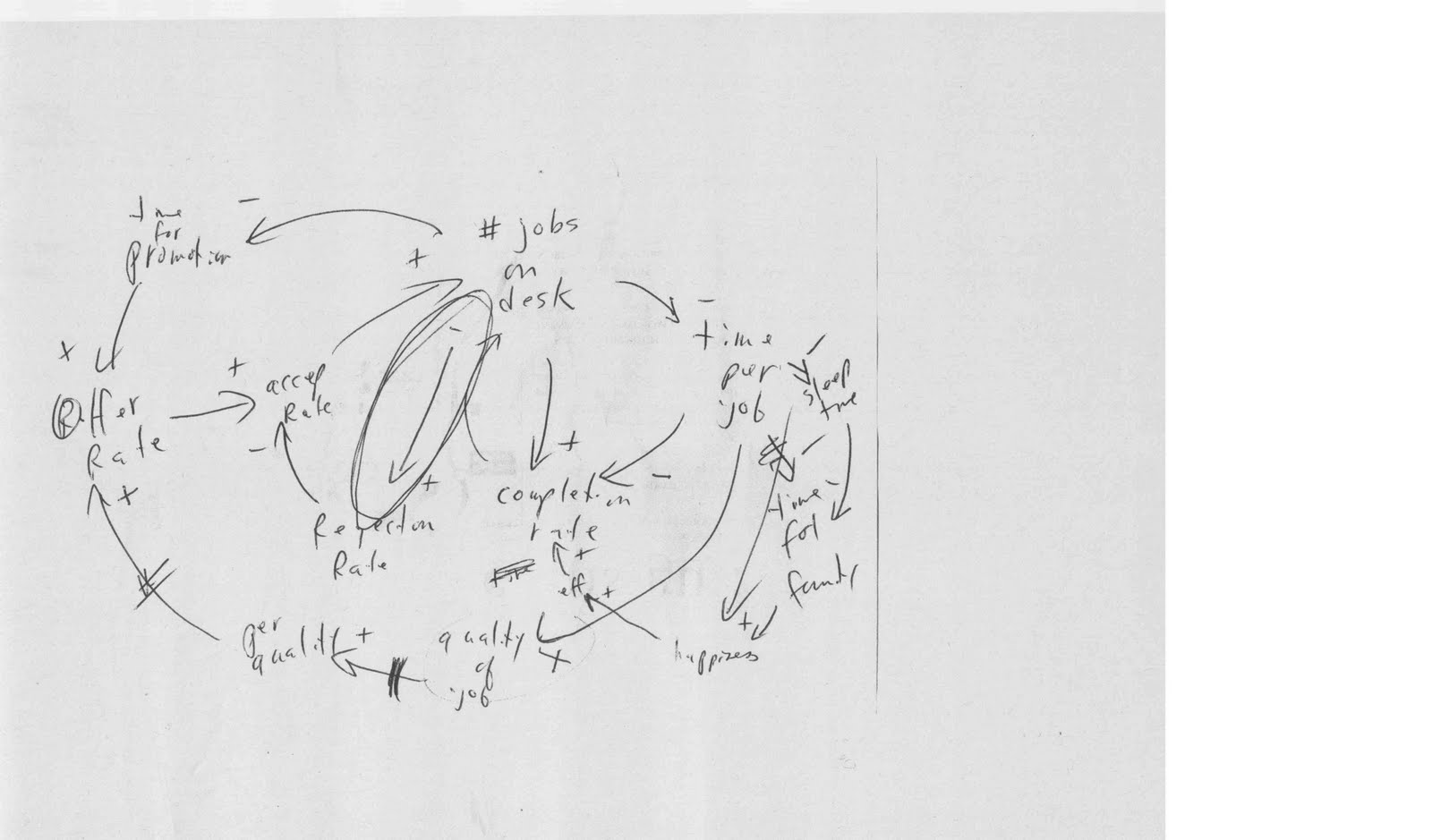
Drawn on a napkin during a recent dinner I had with a systems expert, you might have to look closely to see what this Causal Loop Diagram (CLD) advises. It considers some of the dynamics involved in working independently and wishing to balance work with family life. (Click on the image to enlarge it.)

It connects incoming work and project outputs, time for promotion and what you charge, and the rate of acceptance and completion of jobs. Central to this CLD is the link between reflection rate and number of jobs on your desk - the advice: make sure you always have enough time per job for reflection, and use that time frame as a filter to accept or decline a job (circled link in the centre of the diagram). It is tempting to be flexible on this when you are independent, but the knock-on effects of not paying attention to this important aspect can affect your quality, offer rate, time for family and happiness. A big conversation for a very small napkin...

Friday, April 16, 2010

Paper Free and Fast: Using Posterous for Workshops

I am at a workshop of the International Union for Conservation of Nature (IUCN) Commission on Education and Communication (CEC) in the Scottish Highlands (beautiful, yet not the best place to be when an Icelandic Volcano erupts.) CEC is one of IUCN's 6 expert Commissions, which are global knowledge networks of individual practitioners that contribute to the organization's conservation and sustainability work.

CEC aims to innovate; it is the learning and education-focused network within the IUCN system. New tools, social media, innovative learning has always been an area of exploration for the CEC. For example, in September 2007, it held a workshop on New Learning for the Arab Region at the Library of Alexandria in Egpyt where we looked at all kinds of social media and technologies. CEC makes an effort to test and model new tools and technologies in its work.

This meeting has been no exception, thanks to Posterous (self proclaimed as the "dead simple place to post everything"). We have been experimenting using Posterous as workshop support and it has been working brilliantly, making us virtually paper free, helping with simultaneous reporting, and providing practically instant feedback on group work and planning. Here's how we have been using it:

Set-up

  1. We opened the free Posterous account prior to the event and restricted the membership to the participants, closing inputs and accessibility to those attending.
  2. We sent out an initial email to participants with the URL and information on how to use that, so they had it prior to (if they had time) and upon arrival, and asked them to bring their laptops to the meeting.
  3. We arranged for wifi in our room and helped everyone get on, then we demonstrated Posterous on the first day and had everyone make their first post (posting is done through email message. e.g. post@iucncecmeeting.posterous.com.)
  4. Then we were off!
In-Session Use
  1. No More USB Keys - Presentation Support: There was an updating/reporting session of the beginning of the agenda where people reported on what they had been doing. We asked people to send their PPT to Posterous first (not before they arrived, just before they presented.) We had Posterous open on our screen in the front of the room, and people could either show their PPT through Posterous, or not and simply refer to it, so that people could look at it later. So no multitude of USB keys, no swapping computers, and no asking after the fact for people's slides sets or sending them around by email (or worse, printing them and handing them out).
  2. Instant Stars - Real time photos/videos: At ramdom points during the meeting, someone with an I-Phone (me in this case), took short videos asking people for opinions about the meeting, or talking about their inputs, as well as photos, and immediately sent them to Posterous as an attachment to an email for people to see and hear as the meeting progressed. They uploaded in a minute to Posterous and were embedded within the blog space, complete with title and tags.
  3. Nothing Lost - Group work immediately captured in different formats: No longer do people need to take flipchart paper home to type up group reports (or lose), nor stay up at night to do it. We had people in small groups type results directly into Email as they were being produced and at the end of their group work, post them to Posterous. We also had people photo their flipcharts and send the photo. You could even use your phone to video one of your group members talking through the flipchart and post that to Posterous. All this happens simultaneously. We also did our workplanning like this and it is the first time I have left a meeting where all the workplans are done and on the web, accessable to all, and forming some kind of "officialness" that helps tracking and generates commitment. (And can be tagged to organize)
  4. Meeting Done, Reporting Done (Collectively): If everyone is posting things as they are being created - including discussion products, workplans, photos, videos, and attachments, interesting URLs - when you walk out at the end of the meeting, the reporting is effectively done. There is perhaps a short tie-it-together synthesis, but all the documentation produced is already there.

We are just about to end our meeting, and no paper has been circulated, no flurry of USB key swaps, or promises to send around this or that. It's done, organized neatly on the simple Posterous interface, and we all have access to all the inputs, products and materials, to get on with once we return home. And we all contributed to it, through the simple means of email.

Monday, April 12, 2010

IUCN's Commission on Education and Communication: Exploring Social Media Opportunities for Environmental NGOs


This video link was sent to all of us attending the upcoming meeting of IUCN's (International Union for Conservation of Nature) Commission on Education and Communication. I'm proud to be the Specialty Group Leader for a Community of Practice focused on Learning and Leadership, a group which itself explores new learning approaches. I hadn't seen this video on the Social Media Revolution yet, and enjoyed its concise and in-your-face delivery. It rings true from what I have been hearing at the various conferences, from Online Educa last year, to the Social Business Summit last month. It will be interesting to discuss it with this group as I have not seen very big pick up of Social Media in the large international environmental organizations in Europe. Looking forward to getting some good examples to share after this meeting later this week.

Thursday, April 08, 2010

The End of Boring: Borrowing, Adapting, Mashing for Facilitators

I had a design conversation this morning for a one-day workshop that featured 10-15 participants each individually presenting project ideas, one after another. How do you make that interesting (after the third one)? Why not a pecha kucha or an Ignite (the tag line is "Enlighten us but make it quick")?

Both are presentation techniques with origins in the design and IT world which give presenters 20 slides on autochange at 15 seconds (ignite) or 20 seconds (pecha kucha), for presentations that total no more than 5 or 6 minutes. Both are now global phenomena, yet far from being household words. Pecha Kucha has a good website with samples, and here's one using Pecha Kucha for sustainability. Some good videos of Ignite presentations are on the Ignite Oreilly site, with more on Igniteshow).

These techniques shifts the whole emphasis refreshingly onto the story and the images and makes it much more fun and creative. One website said, "This is not your father's PowerPoint presentation." It all might sound intimidating, but even bad ones are really good (or at least funny and only last 5 or 6 minutes anyways.)

So there are new ways to do presentations, there is also new software for that. Lizzie wrote recently in our blog about Prezi, and what about Keynote that I recently heard enthused over by a super smart 11-year old attending a workshop with his mother (a reaction to the slideset no doubt). In fact, there are 40 listed in wikipedia under presentation programme from AdobePersuasion to VisualBee. It probably has never crossed your mind to try anything but PowerPoint, but if you only have 6 minutes to present something or if you want to get people's attention in a long series of presentations (or just a long day), it might be worth trying a new format.

Or what about a completely new format for the workshop itself (or at least Day 2)? We have written about using Open Space Technology in the past (see our post Open Space for Conversation and Eating Croissants) and how that technique helps to organize and support learning. There are a range of Unconference techniques that are being used (many again conceived in the IT sector, and often focused on sparking innovation and creativity enhancements). I heard at last year's Online Educa about the FooCamps and BarCamps that started 5 years ago and promoted as "user generated conferences". Again the content is brought by participants, and schedules are generated by those with ideas to share and develop with others. A typical FooCamp schedule board looks like this (lots of intriguing titles - I like the scribbled out session called "Howtoons" - I would have gone to that one.)

Again, the objective is to provide those people who seem to have at the top of their Job Description: "Go to Meetings", with a new and refreshing frame. A 2006 article about this was explicitly headlined: Why "Unconferences" are Fun Conferences: Unconferences - meetings organized on the Web or on the fly - are becoming the no-b.s. alternative to industry gabfests. The mention of "organizing on the Web or on the fly" comes from the fact that many pride themselves in being organized in less than a week, and are "evangelised" or promoted using mainly web tools. Some recent social applications include CrisisCamps held to promote relief efforts for the Haiti Earthquake. They are also short, with one day or half day formats, and a panoply of parallel, one hour sessions. (And perhaps also a driver for the creation of Ignite or Pecha Kucha type presentation formats).

All this is still a lot of talking. What about having a whole session where no one talks at all? Maybe something like a Dotmocracy session could be a calming and still productive way to spend an hour after lunch. I have seen this done for evaluations, but not as it is described here as a way to gather inputs on a specific idea. If you look at the template, it is obvious how you can use this for brainstorming, and you don't even need those sticky dots that can be a pain to cut anyways. This looks like something that could also work with very large groups, similar to the Camps and Pecha Kuchas described above.

Maybe I am oversensitive to boring. And yet, there are productivity gains to be made from spicing things up, speeding them up, tapping into enthusiasm and creativity, and cross-sector learning from the IT sector - not just from their methods, but also from their eternal willingness to borrow, adapt and mash things up. And for Facilitators, boring is not what we want to pop into people's minds when they think of our work (I was going to say "is the kiss of death" but that sounded rather unappreciative). At least there is no shortage of intriguing pathways to explore, these are just a few, if we want to help try to bring an end to boring.

The Climate Change Playbook: The Making Of

Can you imagine getting an invitation to a workshop that has as its main goal playing 20 games? Would you go?

Those invitations went out a few weeks ago, and we had a very good response to a test workshop we held in Bonn aimed at playing and discussing 20 games that deliver messages around climate change, using systems thinking concepts.

Dennis Meadows, Linda Booth Sweeney and I have been working together for the last few months to take 20 games from the original Systems Thinking Playbook, written by Linda and Dennis, and adapt them for climate change learning. That process is more complicated than you would think! We each have 6/7 games we are working on, originally selected from a larger number in the original book, and folding in climate change messaging is like a dance. You need to deeply understand the dynamic of the game and what happens (or could happen if adapted). With that in mind you need to move your focus over to the climate change world and consider related dynamics, whether in the natural or human (political/economic/social) systems. Then it is an iterative thought exercise to bring those two elements together so that they work elegantly together in the end and are not too contrived.

Sometimes it is very obvious how the game and the key climate change learning points link and relate. And sometimes it is like doing sudoku in your head. It took us from 6-8 hours per game (so far) to make the connection strong enough to use.

There are different ways to make this link (between the game, climate change and systems thinking). You can change the frame of the game to put people in a climate-related context while they play. You can use the debriefing questions to guide people in making the link with the climate debate or dynamic. You can put in data, an observation, quotes from climate specialists, or elements from the news and current events to anchor the game to climate change. Or in some cases you can play the game and ask people what the link is (of course you need to have an answer too in case you draw blank stares).

We tried all of these approaches in the test workshop for our 20 games. They all worked in different ways. Of course, we were fortunate to have a room full of climate and games specialists, which our partners from GTZ (GTZ Climate Task Force) had invited, to play through the games, analyse them and give us great feedback to further strengthen the climate learning.

Our agenda was simply a list of games, and our table of contents will be that too. So we wanted to create a of narrative that held them together, a thread that helped facilitators and educators understand how they might use them. We created two organizing principles for the games day, which we will also use for the book.

First, we used a systems "map" as the organizing principle. This was a stock and flow diagram with stocks such as CO2 in the atmosphere/ocean, heat in the atmosphere, and ice cover, and flows like CO2 emissions, heat in, heat out, ice melting, etc. We had that up in our workshop room and positioned the message from each game around these elements (sometimes before and sometimes after the game). It was not too much of a stretch to map out the lessons from the games - some of which were about natural aspects, and some were more human system dynamics with communication messages, collaboration and competition, etc. We found it useful, and people appreciated this signposting to pull the games together.

The second way of clustering the games was by use. Some of the games are mass games which can be used for large audiences, who might be sitting in an auditorium. They can be used during presentations and speeches to make points, and people can play them sitting in their chairs. Some of the games are demonstration games, which a small number of volunteers can play for a larger group of say 35-50, and the lessons will become obvious to both those playing and watching. The third type of game is a participation game which everyone needs to play to draw the learning, so this would be for a typical workshop size group of 10-25 people.

We also used materials as a criteria for selecting the games initially, not wishing to have any of them be too materials/equipment intensive. In the end, our games kit included: Ropes, balls, coins, paper cups, markers, scrap paper, pens, hula hoop (collapsible), ball of yarn, a newspaper, and a rubber chicken. (I always worry about a customs agent opening my bag in a crowded place.)

We spent 8 hours that day playing our games, each of which run from 2 to 25 minutes in length. We used a 10-minute plenary discussion after each game to identify with the participants ways to strengthen either the game mechanics or the climate change frame and lesson. We also used a Games Review Sheet, so that people could note any thoughts they had during the day individually. I came away with over 50 pages of notes and ideas!

We are now integrating the ideas, revising our games and their write-ups, each of which is from 3-5 pages and written for the facilitator. There is still plenty of writing to do to produce the book and we hope to finish in July. It never made sense to sit at our desks and write games. This test workshop was an important and useful step in the process. There is a saying in gaming that you have to test play a game 10 times before it is really good. We have all played these games dozens and dozens of times in their original format. But they're different now in some subtle and important ways, so this was an important step in "the making of" The Climate Change Playbook.

Monday, March 29, 2010

Search Revolution: Social Media Can Save You Time (With a Little Help from Your Friends)

Many people say they don't have time for social media, are not on Facebook, can't follow the flow of Twitter, don't keep up with LinkedIn, never tried a ning, would never bother with a blog. They have too much email, spend too much time on the internet already looking for things; they simply don't have time to get into these new information streams. "Time wasters" they say - "Where do you find the time?" they ask.

Would they ever believe that using social media might actually save them time? This is what the experts are saying, and they point to the coming revolution in Search.

I recently went to the Social Business Summit in London, and this was one of the big discussion topics - the change in how people will search for information in the new social media environment. It was predicted that in 5 years, Google would no longer be the way we get our information. Google would be out, and our Friends would be in.

Instead of googling something and getting either 1,300 pages of nothing good for too specific searches (e.g. "lighting shops" + my village in Switzerland), or 11,300,000 pages for searches that are too broad ("light shops Switzerland"), people will increasingly use their social media networks of friends and followers to get the granuality of information they need to answer their questions, fast (e.g the Facebook Group that some women in my village set up called "Move and Improve" that shares information on home renovation and local vendors, in English no less). I will never google local electricians again.

Along with this, out goes celebrity advertising. We will no longer want to know what kind of watch to buy from Tiger Woods, we will go directly to one of our friends whom we know has done recent research in watches locally (because she is writing about it on her blog). Now that we have so much more information on our Friends and their preoccupations, whether through their Fan Pages or the discussions they start on LinkedIn Groups, or their incessant Tweets on one topic or another, we will begin to use these more personal filters, much closer to home and our interests, to shortcut our own lengthy research through broad search pathways. Our Friends rate things, they vote, they share their favorite links, videos, photos. And, because of our personal connection, if we ask them a question, they will probably respond.

And our Friends are not only social, we have our Plaxo's, our LinkedIns, our nings, our professional networks with their Web2.0 platforms where we can ask for and get work-related information, from those whom we know are experts in our topic-of-the-day.

Our Personal Knowledge Management Systems will become a connected web of Friends whom we know personally (or at least virtually), and where we will go for all kinds of information. They will become our Search engines of the future. Hours and hours of Google out, a quick check with our Friends in.

Thursday, March 25, 2010

Preparing a Presentation? Read this Praise for Prezi

When preparing to give a presentation, how do you get started? A list of bullet points? Opening a PowerPoint and jotting down a key message for each slide? Browsing your folder of favourite images to highlight your ideas? Or perhaps like me: with a large table, a big blank sheet of white paper, and an array of colourful pens, sketching out visuals, words and key symbols, with circles and arrows highlighting the connections and helping navigate about the page?

If you are like me, then you’ve probably struggled with the transition from your sheet of beautifully animated paper to a series of PowerPoint slides. All of a sudden, the dynamism, the creative flair, the energy seems sucked right out. Despite your best efforts, clicking through the slides you are disheartened by the linearity, and frustrated by the challenge of retaining the contextual frame for each of your interestingly connected points – a frame which leapt from your one pager. If this speaks to you at all, I have just the presentation tool you’ve been waiting for: Prezi. Check it out here: www.prezi.com. It’s very intuitive to use, and makes a really refreshing change. Systems thinkers especially – this is absolutely for you!

Let me know how you get on.

Friday, March 19, 2010

Next Generation: Climate Change Preparedness Meets Social Media

I am just about to comment on a PPT presentation that a couple of elementary school students made about what to do in case of a tornado (Among other things: Seek shelter under a sturdy table in the basement. If there’s no basement available, go to a first floor, small bathroom opposite of the tornado. Did you know that?) A teacher in Pickerington, Ohio (population 9,792) is running a timely project with his class on extreme weather conditions, what causes them and what to do.

But they aren't making posters and standing up in front of their class (well, they might be doing that too.) They are doing their project using social media, so their learning becomes the learning of many. The students are doing their reports on tornadoes and hurricanes and the like in PowerPoint (with very nice visuals and lessons in word count that any good conference presenter should know). They are posted on a website in blog format, and they're inviting comments through word-of-mouth viral spread from all over the world. To incentize interaction, they are giving the teams with the most comments, and with the comments from the furthest away, a prize. (Thus the reason I was called in I guess - an Ohioan who cares about tornadoes, based in Switzerland.)

The comments they are getting are interesting too, lots of positive feedback on their delivery, extra information and geographical comparisons from people who live far from their small mid-western town. No amount of classroom interaction would get them that.

I'll put the link here, just for now, in case you want to go and give them some information on extreme weather events from your part of the world. As our climate changes and social media is just the way things are done, these kids will be doubly prepared!

Saturday, March 13, 2010

An Amazing Group of People: Have a Party, Play a (Social Learning) Game!

Last Friday night I went to a birthday party that a friend of mine threw for herself. It was a nice group size, 10 women, that she had drawn from various of her different social groups. Because of this diversity, everyone knew somebody, but no one knew everyone, except for her. So she decided to play a game, as a way to bring the group together and get conversation going.

At the beginning of the party, in front of the fireplace, we all sat together searching around for things to talk about with one another, work, school, family, our origins - the usual conversation suspects. Going on in parallel, as people came in, my friend would hand them a small piece of paper and a pen and asked them to write something about themselves that was interesting and that the others might not know about them, and give it back to her. The first reaction in almost every case was, but I haven’t done anything interesting! Stumped, people held on to those papers until the very last minute when they would finally write something down and hand it back.

My friend put all the papers aside as we started dinner, and indeed there was one conversation going at one end of the table about school, and another at the top of the table about another topic, and a few people like me in the middle trying to listen to both, but not quite managing to jump in. At that point, getting our attention, our hostess announced that we were going to play our game. She told people that she was going to read one of the statements and that the table would have to guess who had done what. People laughed nervously at first, apologetically restating that they had simply not been able to think of anything very interesting. Then we started, my friend began reading the statements one at a time….and... within minutes we were in an uproar, bursting with laughter, incredulous with disbelief!

This amazing group of people had been all over the world and done remarkable things – someone was being quietly paid to go by train every Friday up to Gstaad one of the world’s poshest ski resorts to teach flute lessons to a couple of students living there (we never found out who they were), one person had competed nationally in Latin Dance competitions and danced in stage shows, another person had a long list of movie stars that she had bumped into (some literally) in New York City and great stories to go along with these, someone else had worked as a forensic DNA research specialist in Costa Rica and mesmerized us with the story of CSI-like drug-related murder that she had worked on and helped solve.

What a completely different conversation we had after that! No more super small talk, there was no going back.

With that small game, not only was the conversation brought together, giving us a shared experience, it also produced an opportunity for us to connect with each person individually, making finding further conversations topics a breeze. We also quickly went to much deeper quality connections, and more memorable ones. I will probably never forget these things I learned about these women, and when I see them next I will be able to reconnect with them in a much different way thanks to this relationship building shortcut. It was a service to social learning too, knowing more about what people do and can do, if anyone asks me for a good music teacher, I know where to send them.

This game also created lots of good energy, and that relaxed people who did not know one another. It helped us share things about ourselves that we are proud of, but that would have never come up in a normal cocktail party conversations (like taking blood samples from dismembered corpses), and gave people a real sense of accomplishment; we all left feeling much more “amazing” than when we arrived. Remarkable what a little social learning exercise can do!

If you want to do it yourself, here are the game instructions:

Materials: Squares of paper (1 per person – make sure they are all the same), pens, a bowl to put them in.

Time: 3-4 minutes per person playing.

Game steps:

  1. As people walk in give them a slip of pepole and ask them individually to write down one thing about themselves that is interesting, and that people in the room may not know about themselves. Don’t give them any examples (they won’t really need them), but you can ask them to think about their past, their home or work life, etc. Tell them NOT to write their name on the paper.

  2. Collect the papers and fold them over; put them in a bowl or hat.

  3. During dinner, or when everyone can listen and see you, announce the game and pull the first paper out of the bowl. Tell the person who wrote it not to announce themselves until someone has guessed, or the group is stumped.

  4. Read the first paper, and start the guessing! When the person has finally been guessed, ask them to talk a little about their experience, ask about context, or for a short story (this is where the good stuff comes) and let the group focus on that person for a time before going on to the next paper.

  5. People will naturally keep track of how many they guessed correctly – if you want you can have a small prize for the person who got the most correct.

Variation: In a workshop setting I use this game just after lunch or on Day 2 or 3, as on the first day if people really don’t know one another at all, they will not be able to guess. If people do know one another somewhat, you can move the game up in the agenda. With a larger group, I mix up and number the cards, and then at the start of the game, I ask people to take out a piece of paper and number it from 1 to 15 (the number of people playing), and I read through all the papers first with no out-loud guessing, simply asking people to write down their guesses. Once I have completed one reading, I go back and read them again in the same order (thus the need for numbering!) and this time, we guess and then move into the wonderful sharing and storytelling as people get to tell more about what they can do and know.

Whether at a birthday dinner or in a workshop, you just never know what a gold mine of experience, stories and knowledge you have with you in the room, until you ask, and then let the evening be naturally taken over to learning about your Amazing Group of People.